



Irish offshore first
Killybegs Fishermen’s Organisation (KFO) and Sinbad Marine Services have signed a memorandum of understanding (MoU) with global floating offshore wind developer and technology provider, Hexicon AB.
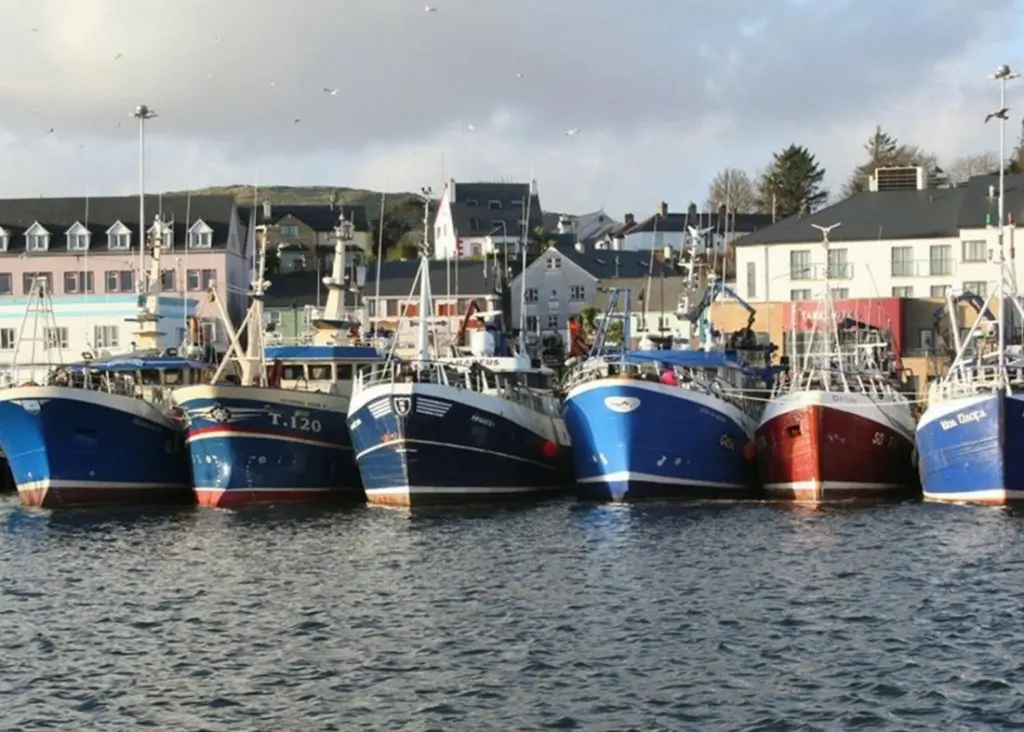
The partnership will see local fishermen engaged and influencing the development process of a potential new farm from the onset.
Similarly, other stakeholders, including environmental organisations will also be given input at an early stage in shaping the location and design of the floating wind farms. In parallel, port operator and marine service provider Sinbad Marine will ensure the floating offshore wind project maximises its engagement with local industry and leverages local infrastructure.
The MoU’s focus is for the parties involved to cooperate and agree solutions which are mutually beneficial for the development of a wind farm which do not negatively impact the fishing industry nor the marine environment while contributing to the transformation of local and global energy supply chains.
Proposed to be located more than 50km off the Donegal coast, the new floating wind farm has the potential to deliver up to 2 gigawatts (GW) of energy. It could also position Killybegs as a leading service hub for the fledgling offshore wind industry as well as helping establish energy independence for the fishing industry and wider region.
KFO’s CEO Seán O’Donoghue said the agreement was a “unique new approach” to how floating wind energy can work in collaboration with fishermen.
“We at the KFO, weren’t interested in being presented with a fait accompli nor lines drawn on maps by any prospective developer. In signing this MoU, we have guaranteed that we will be at the centre of a project which has the potential to be an economically-transformative. Offshore wind is coming and with the KFO seeking out a ‘new approach’ to partnering with a suitable developer, we have put ourselves in pole position to harness a historic opportunity for the northwest,” O’Donoghue said.
“As an early-stage developer of floating offshore wind projects, coexistence is at the centre of what we do. It is absolutely essential that we base our projects on constructive dialogue and collaboration with key local stakeholders and regional organisations. We hope that this can serve as a precedent for other offshore wind developers globally,” said Marcus Thor, CEO of Hexicon.
Sinbad Marine Services’ Managing Director Jim Parkinson added that providing a stable supply of clean energy will help Killybegs become the first green port in Ireland.
A Phase two Marine Area Consent (MAC) will be applied for under the new Marine Area Planning Act. The Maritime Area Regulatory Authority (MARA) which is soon to be established, will manage permitting of all offshore projects by issuing a MAC to all qualifying projects.
Award of a MAC in turn, allows the developer to make an application for planning permission to An Bord Pleanála.
It is intended to use part of the energy generated to produce green fuels such as hydrogen or ammonia which in turn could be used to power the fishing fleet whilst also contributing to energy security for the port and local community. This initiative will require some 6,400 tonnes of hydrogen annually.
Contingent on adequate grid reinforcement being provided, the remainder of the energy will be connected to the national grid and contribute to Ireland’s stated target of 5GW from offshore energy by 2030. Ireland has the potential to generate at least 30 GW of offshore wind.
Related Articles
 FISHERIES
 FISHERIES
 FISHERIES