






EU issues Indian Ocean tuna proposals
Four proposals to improve the conservation of tuna and the management of fisheries for the next Indian Ocean Tuna Commission (IOTC) session, taking place from 8 to 12 May 2023, have been made public by the European Commission.
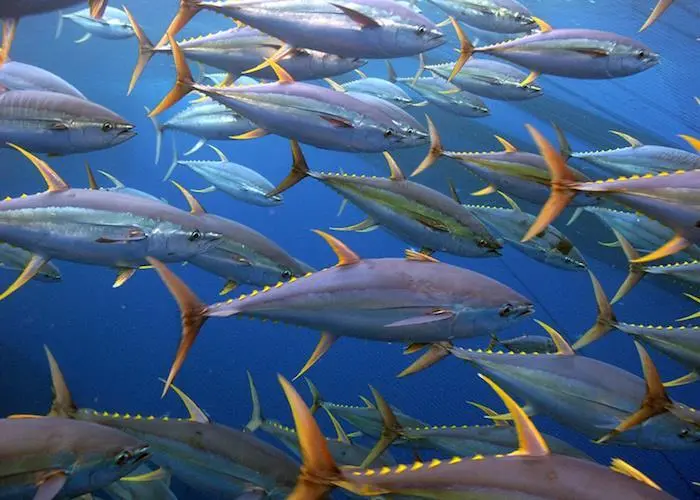
Along with the new proposals, the EU has tabled an objection to the IOTC Resolution 23/02 on the management of drifting fish aggregating devices (FADs).
“With our proposals for the IOTC, we aim to improve the conservation of tuna and drastically reduce the illegal, unreported and unregulated (IUU) fishing activities. We are also proposing a revised resolution on drifting fish aggregating devices as we consider that some provisions of the resolution adopted in the February are not implementable and unclear and not based on scientific advice,” EU Commissioner for Environment, Oceans and Fisheries Virginijus Sinkevičius said.
Sinkevičius also said the EU hopes that in the coming session, IOTC members will work in a cooperative manner and through consensus.
The EU’s four proposals are:
- A multi-annual plan for the management of tropical tunas, to improve the management of the three tropical tuna stocks (yellowfin, bigeye and skipjack). This plan would last for three years and would bring down the level of catches in line with the scientific advice. Within the plan, the EU proposes a proportional catch reduction taking into account both the current level of catches for each IOTC member and their development status to ensure that developing countries are treated fairly
- A scheme for the boarding and inspection of vessels in the high seas
- An update of the rules of the IOTC Compliance Committee to improve the compliance process to make sure that fishing activities are conducted in accordance with applicable laws, regulations, and conservation measures
- A new resolution for the management of drifting FADs to replace Resolution 23/02, adopted in the February special session of IOTC. The EU’s objective is to improve the obligations that are technically difficult to implement, to clarify unclear provisions, and to align the text to the scientific advice
With regards to the EU’s objection to the FAD resolution, the Commission said that in the February 2023 IOTC special session on FADs, Resolution 23/02 on the management of drifting FADs was adopted by majority vote, against all IOTC members fishing on drifting FADs.
It highlighted that as a result, many IOTC members have lodged an objection to that resolution, including the EU, the Comoros, Oman, Kenya, the Seychelles and the Philippines.
“The EU believes that IOTC members should work in a cooperative manner and all efforts should be exhausted to reach consensus. Conservation measures should not include provisions that are not implementable or unclear. It is also essential that management decisions in RFMOs are underpinned by scientific advice,” the Commission said.
It continued: “Following their objection, the objecting countries, will not be bound by this resolution and will not have to implement all its provisions.”
The EU became a member of IOTC in 1995. The other members of IOTC are Australia, Bangladesh, China, Comoros, Eritrea, France on behalf of its overseas territories, India, Indonesia, Iran, Japan, Kenya, Korea, Madagascar, Malaysia, Maldives, Mauritius, Mozambique, Oman, Pakistan, Philippines, Seychelles, Somalia, Sri Lanka, South Africa, Sudan, Tanzania, Thailand, the United Kingdom and Yemen.
Related Articles
 PROCESSING & REFRIGERATION
 FISHERIES
 FISHERIES