




EJF condemns ‘tainted’ Chinese seafood supplier
The Environmental Justice Foundation (EJF) has reported troubling revelations surrounding the operations of the Chinese seafood supplier, Zhejiang Ocean Family Co Ltd (ZOF).
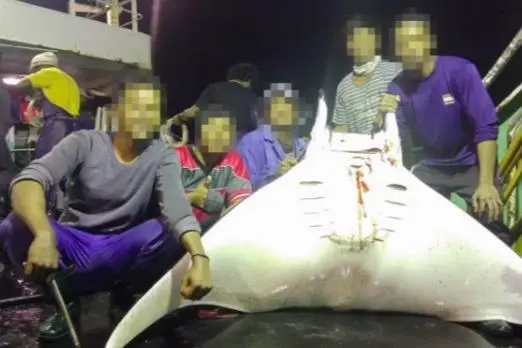
A new report by EJF said the company’s operations are “tainted” with human rights abuses and environmental destruction and that seafood could be entering international supply chains on a significant scale, ending up on the shelves of household-name retailers.
“We have uncovered a systematic web of exploitation orchestrated by the ZOF fleet, with human rights violations and deliberate wildlife decimation likely reaching into the global market,” said Steve Trent, EJF CEO and founder.
“The Zhejiang Ocean Family has been getting away with illegal fishing and human rights infringements for far too long. It is time stakeholders and governments alike finally step up to regulate the industry. The fish on our plates must not come at the cost of people, wildlife and our shared natural world.”
Damning report
EJF’s report, which draws on crew members’ testimonies, photographic and filmed evidence, AIS data and open-source intelligence, outlines the IUU fishing and human rights abuses committed on the company’s vessels.
It found that 12 vessels owned or chartered by ZOF or its subsidiaries were involved in human rights abuses and/or illegal, unreported and unregulated (IUU) fishing activities, such as shark finning and the deliberate killing of cetaceans.
One fisher aboard a ZOF vessel reported his boat would catch turtles, sharks, whales and even penguins.
Human rights abuses were also reported across these vessels, including physical abuse, salary deductions, human trafficking and forced labour, which crew told EJF led to the suicide of one crew member due to depression and the death of another due to illness.
Public company records, released as part of a failed attempt to list the company on the Shanghai Stock Exchange in 2023, reveal connections with major international seafood distributors, including FCF, Mitsubishi, Maruha Nichiro Corporation and Tri Marine Group.
These companies in turn supply many household brands including Amazon, Bumble Bee Foods, Rakuten, Walmart, Marks and Spencer and Carrefour. EJF said that there is no suggestion that any of these companies were aware of the abuses perpetrated by ZOF, but they may have unknowingly sold products from the 12 vessels investigated in the report.
ZOF, a major seafood industry player with extensive Chinese and global seafood supply chain links, contributed 14.63% of China’s total tuna production in 2020.
The Chinese government has provided substantial subsidies to support the fleet, amounting to US$10.9 million in 2019, US$12.1 million in 2020 and US$11.3 million in 2021.
Under Chinese law, these subsidies are liable to be recouped from companies responsible for abuses such as those reported in this investigation, but EJF said there is no indication this has taken place.
The investigation recommendations to flag states, port states, market states and relevant Regional Fisheries Management Organizations (RFMOs) to address the need for transparency, sustainability and ethical fisheries.
EJF calls on stakeholders, governments and organisations worldwide to promote positive change in the industry, in particular by enshrining the principles of the Global Charter for Transparency into law.
Related Articles
 FISHERIES
 FISHERIES
 FISHERIES