



Scientists from China have visited the University of Stirling in Scotland to explore how world-class research facilities are shaping innovation and best practice in global aquaculture.
The group – from the Chinese Academy of Fishery Scientists (CAFS) – toured the University’s new National Aquaculture Technology and Innovation Hub (NATIH), a £21 million research and development centre at the Institute of Aquaculture.
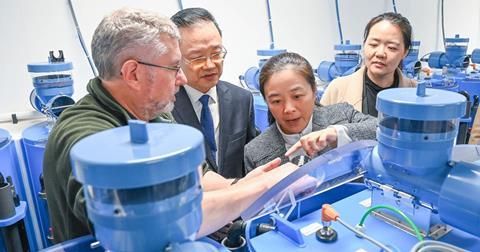
“China is a major player in the global aquaculture industry, and its growth trajectory is set to continue,” explained Professor Trevor Telfer, acting head of the Institute of Aquaculture.
“By working collaboratively to fully utilise the combined strengths of our knowledge and facilities, we can play a critical role in ensuring that growth is sustainable and offers the best outcomes for producers, consumers and the environment.”
The hub enables a broad range of academic research and commercial trials aimed at tackling emerging challenges across the fast-growing aquaculture industry, including climate change, disease control and sustainable production.
Aquaculture is expanding globally at around 8% per year, with China accounting for almost two-thirds of total production. However, this rapid growth also poses major environmental and economic challenges for producers worldwide.
“As China’s national academy dedicated to fishery sciences, we are pleased to note that both sides share extensive common interests,” said Professor Yu Shuzhou, head of Discipline Inspection Group at CAFS.
“We firmly believe that this collaboration will enable us to achieve mutually beneficial outcomes in both research and innovation.”
NATIH is funded through a £17 million UK government investment via the Stirling and Clackmannanshire City Region Deal, alongside contributions from the Wolfson Foundation and the University of Stirling.