




Beloved regional fish curimbatá is emerging as a key export species for the country’s aquaculture industry. Its low-cost farming and growing demand in neighbouring countries are driving rapid international growth.
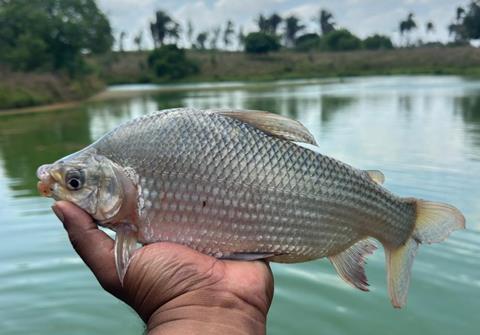
Commonly appreciated in the Brazilian countryside – especially in northeastern and northern regions – curimbatá (also known as curimatã and other regional variations) has been conquering new markets over the past couple of years, becoming the South American country’s second most exported farmed fish species.
Part of the Prochilodus genus, curimbatá is a type of ray-finned fish naturally encountered in a number of river basins in Brazil, from the Amazonian territory to the Southeast of the nation. Producers have also been farming it in different Brazilian states, especially in the Amazon region.
Tilapia continues to dominate Brazil’s farmed fish exports with over 94% of the total volume (a lot of which goes to the United States). Last year, Brazil exported 12,463 tonnes of tilapia, generating an income of over US$ 55 million. But curimbatá exports have been rapidly growing, with an upturn of 437% in the volume of fish exported between 2023 and 2024. Brazilian fish processing companies sold 653 tonnes of curimbatá to overseas markets last year, generating over $1.2 million. And in the first-quarter of 2025, curimbatá exports grew 33% year-on-year. The major buyers are Peru and Colombia.
“Venezuela has also been a relevant importer of curimbatá, as well as Panama,” affirmed Francisco Medeiros, President of the Brazilian Pisciculture Association (PeixeBR).
Medeiros explained that curimbatá is a staple dish for people from northeast Brazil. With their migration to the Amazon during the rubber boom at the end of the 19th century and to the southeast during the most recent wave of industrialisation (especially between the 1960s-1980s), the species became known all over the country.
“In the south, we have to import it from Uruguay and Argentina in order to meet the demand. In the north, we produce it on a large scale and export it to neighbouring countries,” he said.
When it comes to volumes, Maranhão State has been the most important curimbatá producer, he added. According to Edvaldo Franco, who heads the technical and management assistance of Maranhão’s branch of the National Rural Learning Service, fish farming has been growing in the state at a faster pace than in other Brazilian regions, and curimbatá has been one of the stars of the process.
“Maranhão has favourable soil and climate for fish farming, besides its privileged logistical structure. Curimbatá has a high commercial value in our state, at least 40% higher (per kg) than that of the tambaqui, one of the most produced species in the country,” Franco told WF.
Low-cost production
In 2024, Maranhão produced 54,500 tonnes of farmed fish (the previous year’s production amounted to 49,143 tonnes). Of this, native fish (including curimbatá) accounted for 39,000 tonnes. It has been produced generally along with tambaqui or tambatinga. With the advancements in genetic improvement, matrix selection, and fry lineage qualification, production has been expanding, Franco said.
Because the people of Maranhão have a cultural connection to curimbatá, demand has been growing. At the same time, almost everything the region produces is consumed by its population or sold to neighbouring states.
“The business is pretty much in the hands of middlemen. We need to improve the fish processing infrastructure in order to meet the growing national and international demands,” Franco said, adding that everything points to more growth in the next few years, given that the demand is strong, the prices are good and handling the species involves less requirements than other types of fish.
Medeiros highlighted that curimbatá is a bottom feeder, eating the waste generated in the tanks by the midwater species that are co-raised with it. “Curimbatá farming almost doesn’t have costs, given that it doesn’t need to be fed. At the same time, it filters the water, improving its quality. It’s the most sustainable species in terms of fish farming,” he said. “In practical terms, the curimbatá transforms effluents into protein.”
It’s also a cheap form of protein. Raised along with the tambaqui, for instance, it attains about half of the other species’ size at the end of a couple of cycles. “If you want to take the tambaqui out of the tank with 1.6kg, the curimbatá will have reached 800 grams, which is commercially a good size,” Medeiros confirmed.
In a world in which billions of people live with less than $10 a day, curimbatá is among the leading competitors among cheap proteins, he reasoned. “Countries like Colombia and Venezuela buy it not only due to their cultural traditions, but also because of its low cost.”
Medeiros compared curimbatá with the Vietnamese pangasius, one of the major fish farming species imported in Brazil. “Last year we consumed over 50,000 tonnes of Vietnamese pangasius – not for its quality, but for its price,” he said.
Extending export potential
Eyeing international markets, PeixeBR has been continuously campaigning for curimbatá joint production by Brazilian fish farmers.
Edson Soares Amaral, one of the owners of Pisciculture Amaral, a fish farm located in the city of Pinheiro, Maranhão State, introduced curimbatá production in its tambaqui tanks in 2016. “Our goal was to diversify the production. It’s shown to be a highly adaptable species in terms of water quality and pH variations,” he told WF.
Amaral explained that in each tank the company introduces a certain quantity of curimbatá – not too many, given that its productivity is better if the concentration is not too high. “When it attains 700 grams, we take it out. In our region, it’s sellable with that size,” Amaral affirmed. The prices have been relatively high, and the demand is strong in Maranhão, he added. Until now, the company hasn’t exported to other countries.
Achilles Ferreira, a fish farmer and consultant, confirmed that Maranhão producers struggle to meet the local demand and rarely sell to other regions. He has been working with curimbatá over the past three years. “I usually complete two or three six-month cycles of the major midwater species and only then I take the curimbatá out of the tank. By that time, each individual has already attained around 1kg,” he said.
The only special care that farmers have to take with curimbatá is connected to thermal stratification. “When it’s too high, the curimbatá tends to die. With a steady environmental temperature, however, there’s no problem,” Ferreira said.
Exports usually come from Northern states. Pisciculture Acordi, located in Boa Vista, Roraima State, has been producing and selling fry over the past 35 years. While the company has been focusing on other species, it also works with curimbatá.
“A major curimbatá buyer is Venezuela, where it’s known as coporo,” said the company’s owner Paulo Acordi.
Curimbatá exports are usually conducted by fish processing companies, not by the producers themselves. That’s the case with Frigopesca, located in the city of Manacapuru, Amazonas State.
Raimundo Chicó, Frigopesca’s owner, told WF that he has been exporting curimbatá particularly to Peru and Colombia, where it’s much appreciated. “We began exporting curimbatá over the past couple of years. Both the production and the exports will grow,” Chicó said.
Frigopesca, which has been operating over the past 30 years, will now begin to produce curimbatá too, he confirmed.