

Technology in high energy operations
The first session of this year’’s High Energy Mariculture Conference began with a range of examples on how to successfully maximise production offshore through technology.
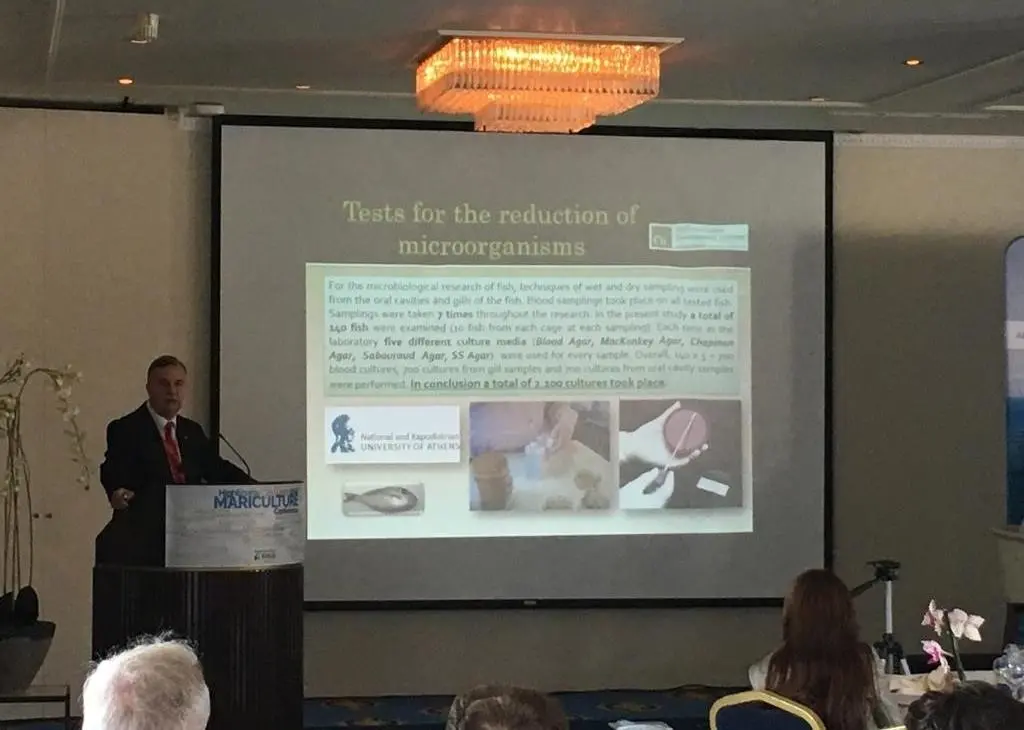
Jon Espilla of EMEA, Badinotti Group S.p.A spoke early in the session by highlighting recent government moves to push for offshore farming technology. A number of reasons were given for this, including conflicts among stakeholders (e.g. tourism and fisheries), a lack of suitable sites on land, and the risk of pollution, fouling, reduced water quality and algal blooms.
Jon then introduced his company’s new submersible fish pen, the Oceanis III, which is still in the experimental stage. With a circumference up to 160mt, a net depth of up to 18mt and a volume of 36,500m3, the new cage is cheap, light, with modular and customising dimensions, has fast, horizontal sinking and lifting, with automatic trim control and no need for special mooring.
“Submersible cages are sheltered from the weather, there is a smaller risk of structure failure, the fish won’t be stressed in rough weather, while farming at a lower depth means more stable oxygen and temperature levels as well as less productivity of toxic algal blooms.” Jon explained.
Examples of successful partnerships between aquaculture and other industries such as brass were given. Often asked why his industry has gone into partnership with aquaculture, Daniel Steitz, Head of Aquaculture at Wieland Group explained that aquaculture was a chance for his firm to become a part of one of the fastest-growing markets. But how can a new industry learn from a traditional industry, and what would the new industry need to grow sufficiently?
“Aquaculture is still very young, so we say from our experience in the metal industry that we can apply our process and automation to aquaculture and even take out steps that are not needed, for example instead of changing netting after every production cycle, cages made with our brass net material can be used for several cycles,” Daniel explained.
Shifting to offshore cages, he continued, ticks all the right boxes, with less fouling, minimum necessary maintenance, high mechanical strength and a long line thanks to excellent corrosion, wear and fatigue resistance.
“We are curious how the future will look like with aquaculture, but I’m pretty sure that brass material and copper alloy material will be key to opening the open ocean discussion,” Daniel said.
Copper alloy cages continued to be a focus for the rest of Session 1 when a study on copper alloy cages in floating fish culture for the farming of Mediterranean marine fish was introduced by Dr. Panagiotis Efstathiou, Scientific Consultant at the Hellenic Copper Development Institute. Parameters evaluated during the study, including fish growth, mortality rates and microorganisms in fish tissue samples showed that copper alloy mesh cages create a clean environment for fish, avoid antibiotics costs, reduce maintenance costs including repair work, net cleaning and diving operations, and improve fish health and welfare with significant financial environmental and managerial advantages to modern sustainable aquaculture.
Related Articles
 WORLD FISHING EVENTS
 WORLD FISHING EVENTS
 WORLD FISHING EVENTS