




Setting a new standard
The Rasmussen family from Klaksvík in the Faroe Islands haven’t been shy of making investments in both fishing capacity and activities ashore, and the latest development is the delivery of new pelagic vessel Christian í Grótinum, the most recent in a long line of fishing vessels to bear the name.
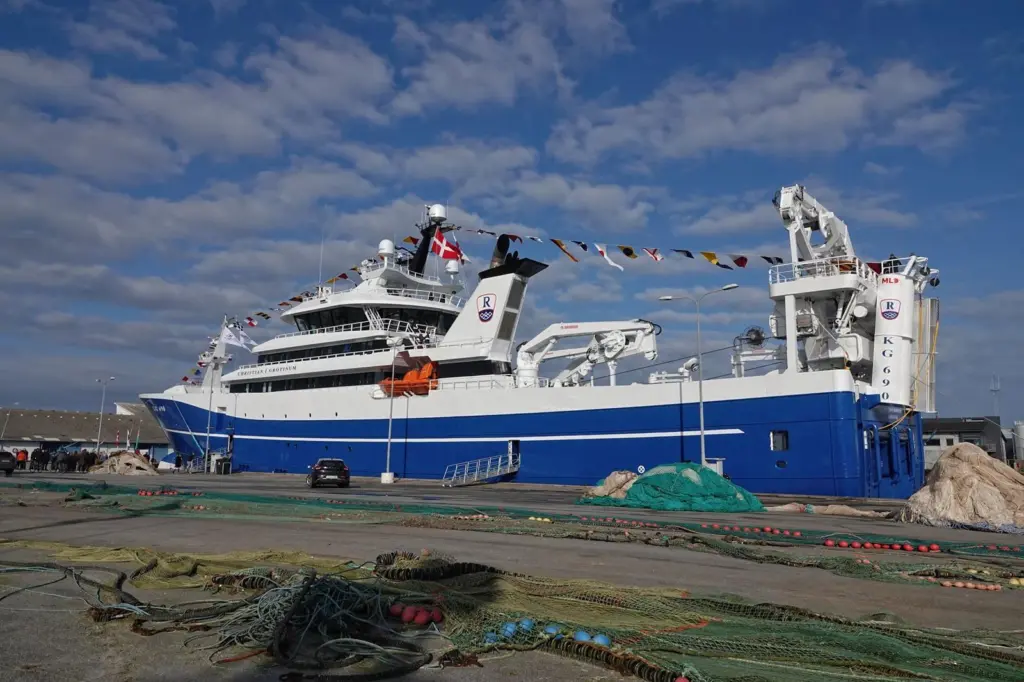
With a length of 89.35 metres and a beam of 17 metres, the vessel has a 3,590-cubic metre carrying capacity in its 16 RSW tanks, and this represents a switch back to landing fresh catches of herring, mackerel blue whiting and capelin, after having operated pelagic vessels with processing and freezing capabilities. The new vessel will operate alongside Norðborg, which was built in Chile in 2009 with a pelagic factory deck and refrigeration capacity.
Behind the new vessel are Kristian M Rasmussen and his sons Eyðun, the company’s technical director, Norðborg’s skipper Jón, and Bogi, who skippers the new Christian í Grótinum.
The Rasmussen family went to Karstensens Skibsværft for their newbuild. Like practically every one of the long series of new pelagic vessels that have been built at the Skagen yard in recent years, Christian í Grótinum is the yard’s own design, and at more than 80 metres and with a reported DKK 300 million price tag, this is one of the largest fishing vessel contracts the yard has taken on.
Design focus
Alongside the recently delivered Ruth, Vilhelm Thorsteinsson and Börkur, as well as Astrid, under construction for owners in Sweden, there is a definite requirement for larger vessels that provide greater range, comfort and carrying capacity, as well as high-efficiency RSW systems and optimum energy economy.
The design process put the main focus on working, safety and comfort for the crew, achieving the best possible catch quality, and optimising fuel consumption. Accommodation areas have been placed as far as is practical from the propeller to minimise sound levels in cabins and crew areas, in addition to other measures taken to make Christian í Grótinum a quiet, comfortable ship. During trails noise measurements showed levels well below all the requirements and recommendations.
Ordered in 2020, Christian í Grótinum has been built at the Karstensen Shipyard Poland in Gdynia, and was brought to the Skagen yard in July 2021 for the later stages out outfitting. The handover took place in the first week of March this year, and skipper Bogi Rasmussen and his crew took the new vessel first to Klaksvík, and then to Fuglafjörður for fishing gear to be taken on board.
Power and propulsion
Christian í Grótinum has a complete Wärtsilä propulsion system, with a 7,320kW @750rpm 12V31 main engine driving a 4,500m diameter 4G1190 propeller via an SCV 112/2-PDC68 reduction gearbox. The SCR system is also from Wärtsilä.
Electrical power on board is sourced from 1,348kW and 940kW Caterpillar 3512 and C32 gensets, plus a 200kW harbour set, although the main engine is intended as the primary energy source for both propulsion and the deck layout, provided via the 3,300kW/4,125kVA Marelli MJRM 710 shaft generator mounted on the reduction gear PTO.
The principle is that when full power is needed, it’s not going to be needed for both deck and propulsion simultaneously. During hauling and shooting, when the winches have a high-power requirement, the shaft generator is clutched in to provide energy, and clutched out as the deck power requirement is reduced.
All electrical power systems on board are controlled by the DEIF power management system.
Further on, a bus-bar breaker is fitted to the main switchboard, allowing aft thrusters to be powered by the shaft alternator and forward thruster and vessel’s hotel load from the diesel generator set.
Electrical power system is fitted for floating frequency (60-50Hz), with frequency converters for 400/440 V and a UPS clean power static supply/converter for 230V. This allows the main engine and propeller rpm to be reduced by 17%.
Christian í Grótinum’s propulsion system is completed with a Kongsberg high lift flap rudder and Kongsberg Tenfjord SR 723 steering gear, a 1400kW Brunvoll aft thruster and a 1500kW Brunvoll AR80 LTC2100 azimuth thruster mounted forward.
Electric deck
The choice went to an electric deck and fish pumping system, with the trawl deck laid out slightly offset to port to leave space on the starboard side for the net bin. Christian í Grótinum has a trawl layout supplied by Ibercisa, with a pair of 97-tonne trawl winches controlled by a Scantrol autotrawl.
The trawl deck is arranged with a pair of 140-tonne net drums lined up with the stern hatches, plus there are storage compartments below the trawl deck for additional trawl gear to stowed.
Ibercisa also supplied the 90-tonne tail-end and top-line winches, a 27-tonne end-wire winch, a pair of net sounder winches placed on the aft gallows and the mooring and anchor winches, as well as the two pairs of purse winches. These are a 40-tonne pair, plus a 15-tonne set of auxiliary purse winches.
The purse-seining rig is from MacGregor Triplex, with a 32-tonne Triplex 1020 net hauler mounted on the starboard side, plus KNR-120 and KNR-75 net cranes, floatline and leadline stackers, a KN-75 foredeck crane and a KN-60 fish pump crane.
Its cranes are run on a high-pressure hydraulic system, powered by a drive system with two 128kW pump units.
Christian í Grótinum is rigged with three fish pumps, able to pump catches on board over the side or from each quarter. These are 20-inch MacGregor Rapp electric pumps, supplied with cable and fish hose reels.
Catches are pumped from the codend or the purse seine and pass to the dewatering box before being routed to selected RSW tanks. The RSW installation on board is a triple PTG FrioNordica system, each of which has a 1,300kW/1.118.000kCal/h capacity.
The RSW circulation system is run with remotely operated RSW-valves through a Wartsila Lyngsø control system. Iras supplied the vacuum system for discharging, with three 3,000-litre tanks and three 87kW compressor units.
Fishing systems
SeaMech supplied the electronic systems in Christian í Grótinum’s wheelhouse, with a variety of Furuno and Simrad equipment.
The two skipper’s chairs face a bank of five 55-inch Olorin screens and a Furuno Smart Bridge that routes feeds from fish-finding and navigation systems into a customisable display. In addition, there are a further 16 32-inch and six 27-inch Hatteland displays installed in the wheelhouse.
The low frequency sonars are 15-25kHz Furuno FSV-25S and 25kHz Simrad ST94 sets and the high frequency set is a 180kHz Furuno FSV-75. The FS-70 headline-mounted sonar and the SN9 purse seine/bow scanning sonar are Simrad units, plus there is a WASSP 80kHz 3D sonar.
The echo sounders are Furuno FCV-38, FCV-1900 and DFF1-UHD sets and the current indicator is a CI-68 from Furuno.
Chart plotters in Christian í Grótinum’s wheelhouse are a 3D Olex system and a pair of MaxSea Time Zero units. The radars, GPS and GPS compasses are from Furuno and the gyro compasses and autopilot are from Simrad. Sailor supplied the V-Sat, GMDSS and VHF communications systems.
Christian í Grótinum is fishing with a both new trawls and fishing gear from the previous vessel. The new trawls include an Atlantica-2600 PEN diamond/hex trawl with an eight-panel belly, supplied by FS for fishing blue whiting.
Vónin supplied 2,600-metre and 2,300-metre Gannet blue whiting trawls, plus an 1,856-metre Seagull trawl for herring and mackerel, as well as balloon and light codends for blue whiting, trawl warps and a comprehensive package of bridles, deck hardware, spares parts and other rigging. The Blue Line trawl blocks are from Brdr. Markussen.
Marport supplied the sensors that provide real-time data on the performance, orientation and position of the trawl gear and the controllable MLD TSS trawl doors. These are adjustable for a surface area from 14 to 19 cubic metres, allowing them to be configured for a variety of trawl gears and fishing conditions.
Related Articles
 FISHERIES
 FISHERIES
 FISHERIES