

SAPMER’s seventh advanced tuna seiner
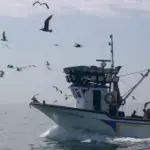
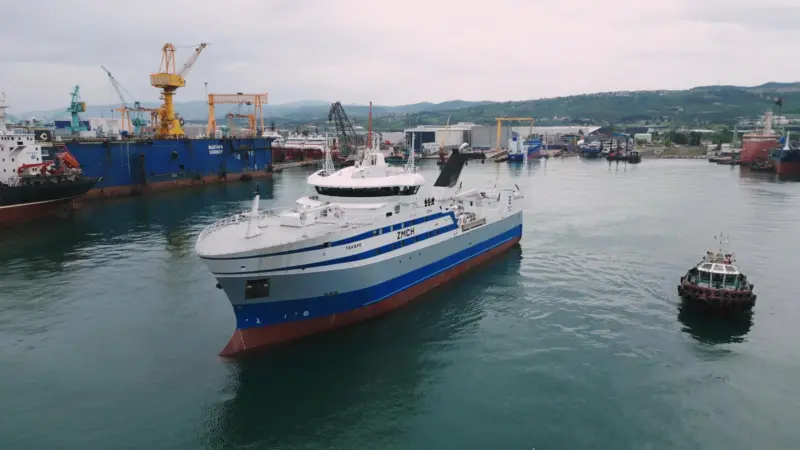
In December 2013 the 90m ‘Belle Isle’ was delivered to SAPMER by the South East Asia Shipyard (SEAS).
This vessel is the seventh in this series of advanced tuna seiners built by SEAS – a subsidiary of the French shipbuilder PIRIOU.
With a beam of 14.5m, the boat will fish a 1.2km-long by 270m-deep net that will be anchored at one end by a 1000-HP power skiff powered by a Cummins KTA38 engine. The dimensions of the fishing equipment are impressive but it is in the handling of the catch that the SAPMER boats show their excellence, reports Alan Haig-Brown. The purse seine winch and power block are supplied by the French firm Bopp.
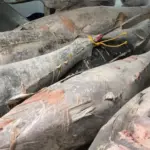
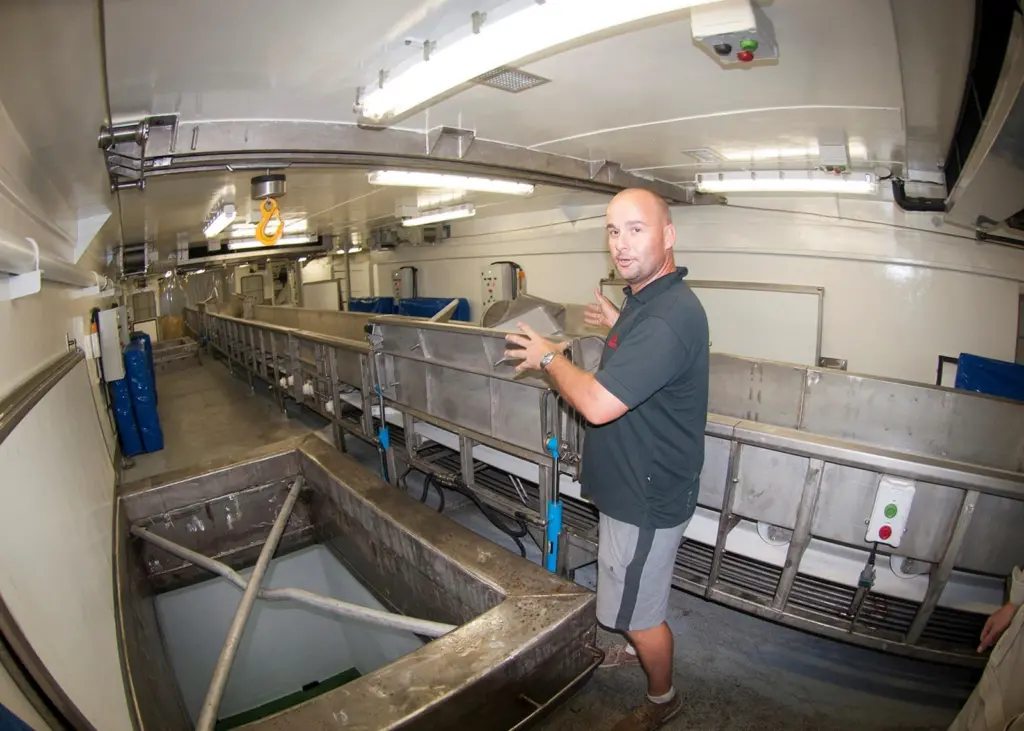
When fish are brailed from the net they are brought to a specialised hatch that delivers them gently to the main processing deck. Here they are moved by conveyor belt to one of eight refrigerated -17oC brine tanks, with a total volume of 539m3. The fish are held in the brine for up to 24 hours, depending on their size, until they have been taken down to -8oC. The smaller skipjack freeze faster than the large and preferred yellowfin.
From the brine tanks, the fish continue their way forward on the conveyor belt to one of six 100t/day freezer holds with a total of 1,470m3. Carefully lowered into the holds by baskets, they are stored there at -40oC. A dedicated eight-man crew carries out all of the fish handling below deck.
In addition to the eight freezer room crew, the Belle Isle has a crew of 25 on deck and in the wheelhouse.
Mauritian flag
The vessel’s captain is Jourdren Laurent, who took the seiner on her maiden voyage from SEAS’ Vietnamese shipyard to Mauritius, whose flag the vessel will fly. After each voyage (which will take no more than five weeks) the catch will be delivered either in the Seychelles or to Mauritius nearly 1,000 nautical miles to the south. In Mauritius the tuna will be processed as required and loaded into containers that will maintain the same -40oC temperatures for their delivery to customers including the high-end Japanese sashimi market.
The careful handling and super cold temperatures as described above are necessary to maximise the value of the catch. To support the demands of these freezers, as well as the extensive hydraulics required for the fishing operations and the vessel’s electric propulsion motor requirements, the owners have opted for an advanced diesel electric system.
At the heart of this are four Cummins KTA50-DM diesels each delivering 1240kW of power at 1800RPM to generator sets. This system allows a wide range of variables to both conserve fuel and/or meet maximum electrical demands including vessel speeds of 15.5 knots. The appropriate generation and distribution of power is managed by the engineering crew from a sophisticated set of interfaces and controls supplied by Canadian firm TECHSOL.
With the engineers concentrating on balancing the vessel’s electrical needs, they can set the monitor on their control panel so that it is replicated on the bridge. The bridge crew can then be informed of the engine room activities at a glance while keeping track of the vast array of monitors that display signals from long and short range radar, as well as multiple sonars that display both 45o and 90o to port and starboard. The vessel also carries and can deploy up to 35 compact solar-powered remote sonars that are set out on rafts and report their signals back to the bridge on the Belle Isle.
Operating in waters that have been prone to pirate attacks, the vessel also carry additional insurance in the form of five armed guards, bringing the total crew size to 38 people.
SAPMER has achieved Friends of the Sea certification for its tuna and is also seeking SA 8000 social accountability certification. For 2014, the company has two 80m diesel-electric tuna seiners under construction at the SEAS shipyard that will be deployed in the Western Pacific Fishery.
Related Articles
 PROCESSING & REFRIGERATION
 VESSELS & SHIPYARDS
 VESSELS & SHIPYARDS