


Damen Maaskant has helped a fishing vessel on its journey to fully carbon-free operation.
From now on, the 43m YE118 owned by Yerseke 118 Noordland will fish for razor shells with an electric propulsion motor.
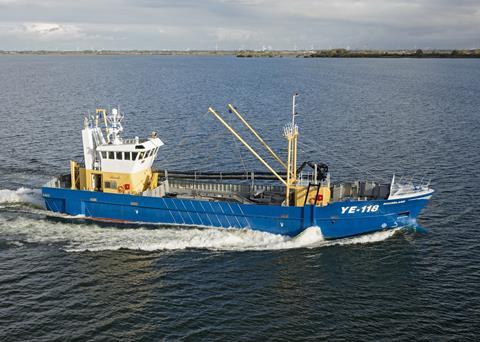
The two companies have been working together since 2015 on safety and catch quality and have now turned their attention to reducing NOx emissions.
“In view of the new Wnb licence for the period 2024-2029, lowering nitrogen oxide emissions in Natura 2000 areas is necessary to receive enough fishing hours and continue fishing profitably.
“Together with Damen Maaskant, we started early so that we can be ready with this before the end of 2023,” said skipper Robbert Mol.
According to Jeroen van den Berg, commercial manager at Damen Maaskant, the shellfish and aquaculture sector is ready to transition to more sustainable operation. “Exhaust gas after-treatment, electrification and the application of batteries are currently the best solutions available for this sector,” he said.
“In the future, this will include the application of e-fuels, which will require the same kind of drives and batteries.”
Electric motor
At Damen Maaskant’s Stellendam shipyard, the diesel propulsion engine on the vessel’s port side was removed and replaced with a 400kW electric motor in cooperation with Wetec.
Yerseke Engine Services replaced the existing C18 generator set with a Greenpower GPC18 generator set with ultra-low NOx mode in early 2023. An exhaust gas aftertreatment system with ultra-low NOx mode has now also been added to the existing starboard Caterpillar C18 main engine.
An interface module that includes the location of all Natura 2000 areas has been added which links to the onboard GPS. As soon as the vessel’s position falls within a Natura 2000 area, the system switches to ultra-low NOx mode and reduces emissions by more than 99%.
After successful sea trials on 21 October 2023, the vessel has already set course for its fishing grounds.