



Renovated research vessel set for action
Renovated marine research vessel ‘Aranda’ has been delivered to the Finnish Environment Institute SYKE ready for use following work carried out by Rauma Marine Constructions Oy at its shipyard in Rauma.
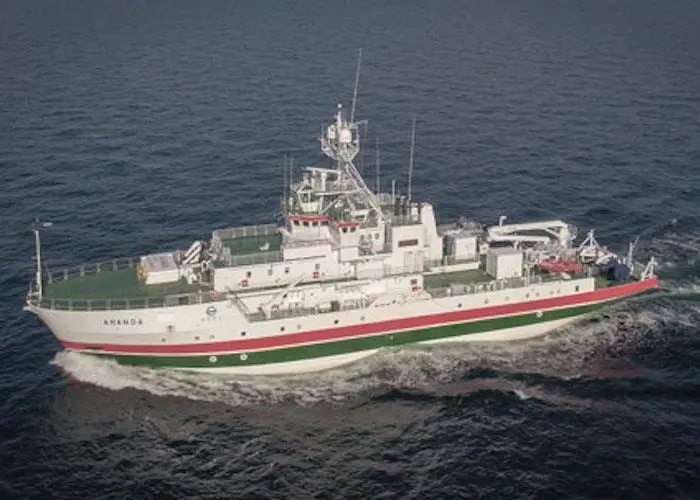
Aranda, which heads out on her first research cruise on the Baltic Sea this month, can now run on biodiesel all year, and it is able to work short periods on battery power only, which will not only reduce emissions but also ship’s self-noise. This will reduce overall environmental impact and make hydroacoustic surveys easier to perform.
Lea Kauppi, director general at SYKE, said: “The renovation guarantees that the Aranda is operational until the 2030s, expanding its potential in research use. With the repairs, the safety of the vessel has been improved and the environmental impact reduced.”
Redesign
Docked for renovation and remodelling in July 2017 to improve its potential for marine research in cold sea areas, Aranda’s refurbishment included a new block being added in the mid-section of the vessel and a redesign of both the ship stern and the after working deck.
The vessel is around 7m longer than before. There is more room for research and laboratory operations, and the vessel is now equipped with completely electronic power transmission.
“The new hull shape and renewed power transmission enable the Aranda to navigate better than before, as well as enhance its energy efficiency and ability to move in icy conditions. It is now much better equipped than before to navigate both in the Baltic Sea ice and in polar areas,” said Jukka Pajala project manager of the renovation at SYKE’s marine research centre.
Key purpose
On its first cruise the ship will first head to the Gulf of Finland and then to the Baltic Proper as well as the Gulf of Bothnia.
The research carried out during the voyage is a part of a monitoring programme by the Baltic Marine Environment Protection Commission (HELCOM), in which the hydrography, nutrients, phytoplankton, zooplankton, algal toxins and microlitter in seawater are monitored. In addition, wave buoys will be maintained.
After SYKE’s research cruise, the Swedish Meteorological and Hydrological Institute (SMHI) will conduct research on Aranda and the Natural Resources Institute Finland will use the vessel to carry out regular inventories of the Baltic Sea fish populations.
Related Articles
 VESSELS & SHIPYARDS
 VESSELS & SHIPYARDS
 VESSELS & SHIPYARDS