



Pelagic pair fitted out with new Triplex net bins
Triplex AS has announced a contract with Larsnes Mek Verksted AS for the delivery of a newly-developed Triplex Net Handling System for a built-in net bin to the new vessels Eros and Kings Bay.
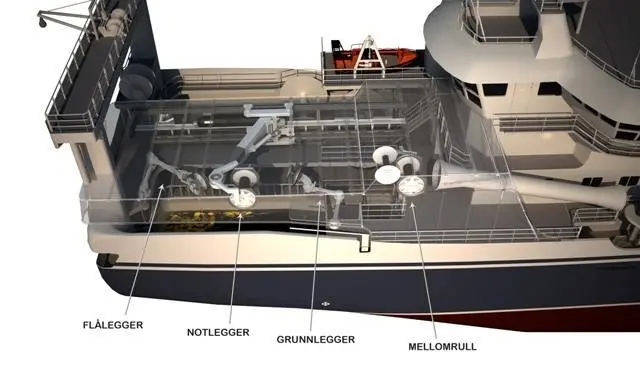
The delivery also includes a 25-tonne net winch and three deck cranes.
Rolls Royce Marine in Aalesund designed the two pelagic fishing boats, which will be completed in 2012.They will each have a gross weight of 2,400 cubic meters and will have a length of 77.5 metres and a width of 16.6 metres.
Triplex’s new system is based on the experience gained from the built-in net handling equipment that has been in operation onboard Libas over the last six years.
The company’s Jan Geir Kristiansen told WF that a close co-operation with both the shipowners and consultants has helped them to reach an “optimal solution in terms of functionality” and to also reduce the height of the net house.
“A larger area for the net bin, especially in the longitudinal direction (approximately 10 metres) resulted in us being able to reduce the internal height by about three metres compared with the net house aboard Libas.
“Such is the way the built-in net handling system now is arranged, that the size of boats have less importance. Both the size and weight of equipment is reduced and can be tailored to the individual boat size. The largest coastal boats being built today will therefore have the possibility to be designed with a built-in net bin,” said Kristiansen.
Simpler foundations
According to Kristiansen, the biggest change from other fit-outs is that the net crane is mounted against the port bulkhead (wall), instead of up under the roof, as was the case on Libas.
“One can thus choose a simpler and lighter structural support, and gain better access to the built-in net bin via a large hatch in the roof, which allows for storage of trawl nets and other equipment, as well as good access to service the equipment,” he said.
The net crane is attached to a vertically-mounted trolley that runs the entire length of the net bin. The crane arm connected to the trolley is telescopic and can swing within a range of more than 100 degrees. The net roller can swing 180 degrees in the horizon plane.
Besides the net crane, the system consists of the following:
- An intermediate roller unit with a hydraulically operated press roller, which allows for continuous adjustment of angle contact and improved friction between the netting and the rubber coated roller;
- A cork line stacker, which separates and lays the cork line at the desired place in the net bin. It can be mounted on the longitudinal trolley for the net crane and run with the net crane, or separately mounted onto a desired location behind the bin; and
- A sink line stacker, which separates and lays the sink line in front of the net bin. A new type of telescopic crane arm simplifies the operation and co-ordination.
The sink line stacker and cork line stacker can be supplied with different arm systems and installation possibilities, said Kristiansen.
All equipment inside the net house is automatically co-ordinated with the net winch so that the operator of the net winch can turn on and operate all equipment from one joystick – either from the deck or from the bridge. A sea-fastening system will be arranged for locking equipment when not in use.
Triplex’s new built-in net handling system was first shown at NorFishing in Trondheim in August 2010.
Both during the exhibition and since, the solution has generated huge interest, said Kristiansen. “Ship designers and owners clearly like it and the opportunity it provides to reduce the height of the net house.”
He said the benefits of a built-in net bin include: improved safety for the crew; it is protected from adverse weather; net handling can always take place under full lighting inside the bin; it provides the opportunity for the vessel to operate securely in poor weather; and it protects the user and equipment.
“With the built-in net handling system you definitely obtain benefits that provide better operating economics. Over time you will see significant savings in reduced maintenance costs of nets and equipment.”
The system is patent protected in Norway under patent No. 320038, and internationally through the PCT No. 04/00348.
Related Articles
 FISHING TECHNOLOGY
 NEW VESSELS
 FISHING TECHNOLOGY