




Order placed for ultra-green pelagic vessel
An order has been placed with the Cemre Shipyard in Turkey to build what is slated to become the most environmentally-friendly pelagic vessel in existence, designed by Norwegian naval architect Skipsteknisk.
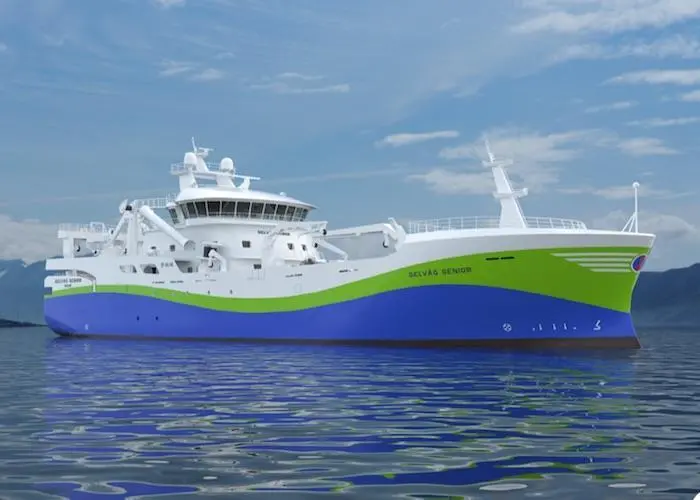
The new 79.50 metre by 16.20 metre breadth Selvåg Senior will be built to a Skipsteknisk ST-136 LNG design, and this isn’t the first time that Skipsteknisk and Selvåg Senior AS have worked together – but this time there are very clear differences between the projected new vessel and its predecessor.
Selvåg Senior’s innovative design and technology and expected to result in a reduction in emissions on a scale new to the fishing industry, by an estimated 42% compared to a similar new vessel using conventional technology.
The new design has evolved during an extended development period, and incorporates capacity for LNG storage, which will be Selvåg Senior’s primary energy source. A vertical gas tank with a volume of as much as 350 cubic metres will occupy much of the forward section – an area that often presents design challenges in fully utilising available space. In this instance, it’s an excellent use of the space, and the vertical arrangement affects overall dimensions less than if a conventional horizontal tank had been chosen.
Liquefied natural gas needs to be stored at a temperature of approximately -160°C, and heated to ambient temperature before becomes a gas use by the main engine. A management system utilises excess heat energy from this process to power the RSW system, while excess exhaust heat is recovered and converted to electrical power, making Selvåg Senior the first fishing vessel in the world to be fitted with this type of technology which ensures minimal energy wastage.
The LNG installation is partnered by a 1mW/hour battery bank, replacing many of the usual functions of diesel gensets, while also flattening the main engine’s energy requirement, plus providing power while alongside. Selvåg Senior is also designed to accept power from a climate neutral shore supply when in port to charge the battery bank.
The ship’s electrical platform is based on a DC-grid arrangement that provides full flexibility in utilising the main engine over its entire speed range. It can most easily be described as an automatic and more efficient handling of the ship’s changing operating pattern and this will also have major impacts on propeller optimisation.
The new Selvåg Senior will be outfitteed for purse seining and pelagic trawling, with options to pump at the stern and over the side.
All the pumps and winch systems will be electric, with capacity to re-route energy to the battery bank.
Selvåg Senior is designed to have a 2500 cubic metre capacity in 12 RSW tanks. The vessel’s owners and Skipstenkisk have been involved in a number of extensive collaborative efforts with research body SINTEF to achieve optimum cooling and circulation in the RSW tanks.
Related Articles
 PROCESSING & REFRIGERATION
 VESSELS & SHIPYARDS
 VESSELS & SHIPYARDS