



Op-Ed: Make 2024 the year that EM becomes ‘business as usual’ in global tuna fisheries
International Seafood Sustainability Foundation President Susan Jackson urges industry to unlock the transformative impacts of electronic monitoring.
As the fourth anniversary of the Covid pandemic approaches, we have another opportunity – individually and collectively – to reflect on what we’ve learned and what has changed (or not changed) because of that experience. In the tuna-fishing community, we can use this milestone to contemplate where we stand today on the sustainability issues we were progressing before Covid dramatically but temporarily interrupted our work.
To prevent a reversal of our hard-won gains, all stakeholders – the International Seafood Sustainability Foundation (ISSF) and fellow NGOs, fisheries scientists, regional fisheries management organisations (RFMOs), government agencies, seafood companies, retailers and vessel owners – must honestly examine where we’ve stalled and why we’re falling short.

Regaining momentum on observer coverage
In the aftermath of the pandemic, our sense of time and urgency has been warped. Post-Covid inertia is real and understandable. Hunkering down in our comfort zones, though, is destructive in an insidious way. If we can agree on one hard truth from the past four years, it’s that there isn’t time to waste.
From my perspective, there’s one glaring example of complacency and lost momentum: the failure to make strides in establishing electronic monitoring (EM) as the norm for ensuring observer coverage in the world’s tuna fisheries.
Even in optimal conditions, we have lacked enough trained independent human observers for all the tuna boats circling the oceans. In addition, many vessels do not have space to accommodate an observer onboard. Early pandemic suspensions of observer programmes, some of which have not reinstated their previous level of coverage, only magnified this longstanding gap. (And let’s not forget that tuna RFMOs still do not require 100% observer coverage, in some form, on all tuna vessels anyway.)
Limitations tend to give birth to workarounds. Pandemic closures and scarcities should have shifted more attention to an alternative to human observers that was “hiding in plain sight” all along: onboard electronic monitoring.
Electronic eyes and ears for sustainable fishing
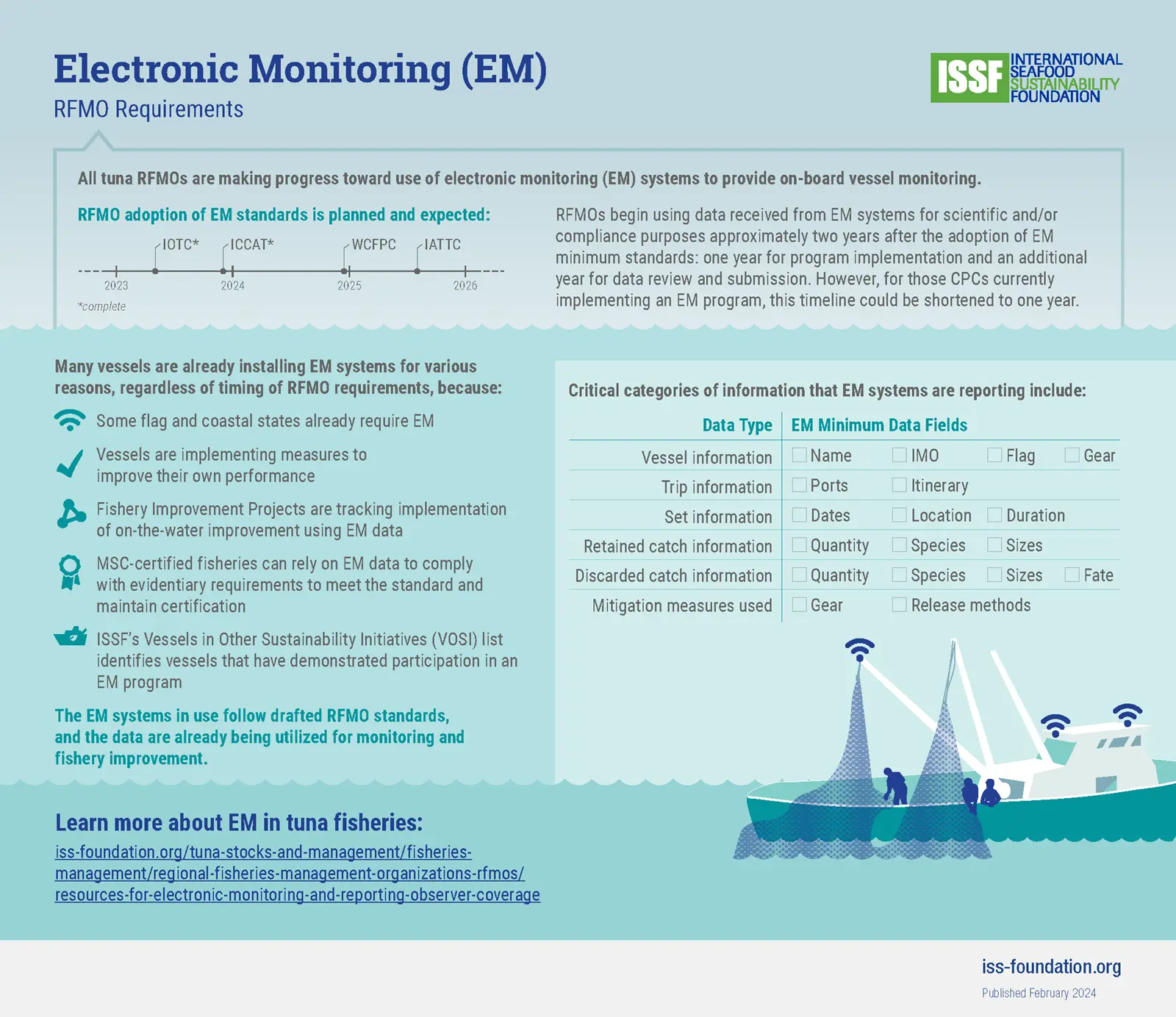
Introduced decades ago, and like other technologies, becoming increasingly sophisticated over time, electronic monitoring systems (EMS) can either substitute for or supplement human observer coverage. Using computers, video cameras, gear sensors and GPS, these systems can continuously and remotely monitor vessel activities — not only fishing trips and sets, retained and discarded catch, and bycatch mitigation practices but also transhipments, landings and other activities.
Like their human observer counterparts, EMS are neutral “eyes and ears” for monitoring, control, and surveillance (MCS) in fisheries. Electronic monitoring systems, when properly customised, installed and maintained, can watch and record video and other data from multiple vessel locations around the clock, which can be reviewed to assess the sustainability of a vessel’s operations and its compliance with regulations.
Proven tool for tuna fishery transparency
Given these benefits, investing in EMS is a “no-brainer.” And the cost of EMS equipment continues to become more affordable for both vessel owners and authorities. Yet EMS implementation remains too low and too slow. It hasn’t helped that until last year, none of the four major tuna RFMOs had adopted standards for the use of EM in monitoring fisheries.
In 2023, two RFMO breakthroughs on EM occurred: the Indian Ocean Tuna Commission (IOTC) adopted EM standards for its fisheries, followed by the International Commission for the Conservation of Atlantic Tunas (ICCAT) establishing EM standards, in this case only for purse seine and longline vessels. These are the first steps in longer journeys, however. RFMOs don’t even begin using EM data for compliance or science purposes until about two years after the minimum standards are established.
In contrast, the Western and Central Pacific Fisheries Commission (WCPFC), which had the foresight 10 years ago to initiate an EM working group, still has EM standards only in draft form, as is true for the Inter-American Tropical Tuna Commission (IATTC).
Against this backdrop, however, some vessels have installed EMS even when not required by their RFMOs: for example, to comply with EM regulations from their flag and coastal states, or to earn or maintain Marine Stewardship Council fishery certification. ISSF’s Vessels in Other Sustainability Initiatives (VOSI) list identifies several dozen vessels worldwide that participate in EM programmes.
Resources and willpower to fast-track EM
We need to expedite global EM implementation in 2024 – not just to return to a pre-pandemic pace of change but to surpass it. Tracking, compliance, and record-keeping systems are business as usual in other fisheries and in other sectors, including finance, law enforcement, transportation and medicine.
Comprehensive observer coverage in tuna fisheries is desirable. Electronic monitoring makes it achievable.
ISSF is among several NGOs creating practical EM resources to help fishers, policymakers and authorities in this transition. We publish EM best-practices reports, EM minimum standards, EM vendor and EM data submission guides, and “snapshots” assessing RFMO performance on EM requirements.
Rather than cling to excuses for resisting and delaying EM adoption: it’s uncomfortable to change; it’s another expense; it’s another new thing to learn, the community could view the situation through our older-but-wiser, post-pandemic lens. Let’s remember what we can accomplish together.
And if we can’t muster our resolve through can-do optimism, we can look at it from another angle: What are the implications for food security and human health in the next crisis if we allow the fisheries that sustain us to go unobserved and unprotected?