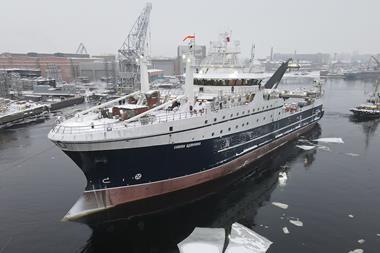




Only a couple of weeks after delivery by Karstensens Skibsværft, new Icelandic pelagic vessel Vilhelm Thorsteinsson was back alongside in Skagen, this time to land the catch from its first trip, 3400 tonnes of blue whiting caught in Faroese waters and landed to FF Skagen.

The new Vilhelm Thorsteinsson EA-11 was welcomed to its home of Akureyri for the first time at Easter, with a muted welcoming ceremony due to the current Covid restrictions which made the customary open ship out of the question.
Built at the Karstensen yard in Poland and towed to the Skagen yard for outfitting, Vilhelm Thorsteinsson and sister vessel Börkur, due for delivery in May to Síldarvinnslan, are designed by the yard with input from the customer.
Contracts for the new vessels were signed back in 2018, and the date chosen was a significant one. September 4th that year was the day that twin brothers Baldvin and Vilhelm Thorsteinsson – both of them highly successful skippers and the fathers of Samherji founders Kristján Vilhelmsson and Thorsteinn Már Baldvinsson – would have turned 90.
The new pelagic vessel replaces an older one of the same name that was delivered to Samherji in 2000, and which was a pioneering pelagic factory vessel, sold to owners in Russia ahead of the arrival of the new Vilhelm Thorsteinsson, which is a dedicated RSW vessel. This indicates a change of strategy, away from freezing at sea and instead focusing on landing fresh catches for processing ashore.
Samherji CEO Thorsteinn Már Baldvinsson joined skipper Guðmundur Jónsson and his crew for the delivery trip to Akureyri.
"This is the third generation of pelagic vessels that I have participated in operating. We decided to entrust this to the Karstensen shipyard,“ he said.
“The ship's main designers work at the shipyard, but Samherji staff have been involved in this process with their ideas, for example, those concerning energy efficiency. So we can say that the vessel is the result of a collaboration between Karstensens and our staff. I think the result is excellent, and it was great to sail home with the vessel. The time with the crew is time well spent.”
3000+ tonne capacity
The 89 metre LOA, 16.60 metre breadth Vilhelm Thorsteinsson has a 3440 cubic metres of tank space, providing a carrying capacity in excess of 3000 tonnes in its 13 tanks. The double 1500kW/hour / 1.290.000 kCal/h RSW system is from Johnson Controls and the tanks have an HL Skjong automated tank washing system with three nozzles in each tank. Iras supplied the vacuum system, with three 87kW compressor units and three 30000 litre tanks.
Designed to operate as a pelagic trawler on blue whiting, herring and mackerel, and to purse seine for capelin, Vilhelm Thorsteinsson has both low- and high-pressure hydraulic deck equipment systems. The low pressure trawl setup is from Kongsberg Brattvaag, and includes a pair of 93-tonne trawl winches and twin 102-tonne net drums, as well as tail end, end wire, net sounder and other winches, plus a pair of 30-tonne purse winches.
Alongside this is the high pressure hydraulic purse seining arrangement supplied by Macgregor Triplex, with a 32-tonne Triplex 1020 hauler, KNR-120 net crane, NK-6000 intermediate roller, corkline and leadline stackers. The KN-75 foredeck and KN-60 fish pump cranes are part of the package, and Macgregor Rapp supplied the two 20-inch electric fish pumps, with cable and fish hose reels.
The Blue Line trawl blocks are from Brdr. Markussen. Vilhelm Thorsteinsson sails with a Hampiðjan 2432 Gloria trawl and an FS Atlantica 2600 trawl. The gear is spread with a pair of 14 square metre Injector Admiral doors.
Twin engines
The engine room is laid out with two Rolls Royce Bergen Diesel B33:45L6P main engines, each delivering power to a Flender GVL-1400 reduction gearbox to drive a 4500mm diameter Kongsberg KaMeWa CPP111A1 propeller.
The provides options for flexible operation, with capacity to run on a single engine during routine operations, while having the power required for heavy trawling by running both engines. Each engine also powers a 2300kW/2900kVA Cummins AvK shaft generator, and under most circumstances a single engine can supply both propulsion power and meet the ship’s electrical power requirements.
The single auxiliary engine is an 840kWe Mitsubishi, plus there is a 166kWe John Deere 6068 harbour set.
In addition to the standard 250 Amp electrical shore connection, there is an 1100 Amp shore connection for use when discharging, providing enough power to run vessel, including gear handling winches. This is the highest capacity shore connection Karstensen Shipyard has delivered for a fishing vessel.
“This is a large ship and it is very well equipped,” said Kristján Vilhelmsson, who heads Samherji’s seagoing operations.
“On board we have all the latest technology for handling catches and the best available fishing gear. A vessel like this, operating with both trawl and purse seine has varying power requirements, hence the two engines. Steaming home, only one was used and under these conditions the ship uses much less fuel.”
Investment
He commented that it is important to remain competitive, and Samherji has invested heavily in new technology, both ashore and at sea. The company’s fleet has been extensively renewed and last year production began at a new high-tech processing plant in Dalvík, while the plant in Akureyri has been extensively renewed.
Sailing from the shipyard in Skagen to dock in Akureyri at Easter, careful precautions were taken before departure. The entire crew and passengers sailing with the ship were screened for Covid before departure, and again on arrival.
Covid restrictions in force meant that the usual welcome and open ship were not an option. Instead, Akureyri’s mayor Ásthildur Sturludóttir presented skipper Guðmundur Jónsson with a bouquet in a simple occasion in the new ship’s magnificently outfitted wheelhouse.
Guðmundur Jónsson commented that Vilhelm Thorsteinsson is a well-designed ship.
‘During the delivery trip we filled the tanks and took a turn at full speed, and the ship hardly listed. It performed extremely well,” he said.
“I have sailed as skipper for thirty years, and I can say with confidence that this is one of the finest fishing vessels I have skippered during my career,” Guðmundur Jónsson said.