




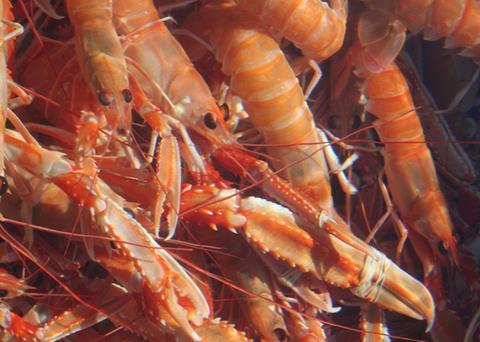
Also known as Norwegian lobster, prawns and langoustine, nephrops are among the most valuable species in European fisheries. For trawl fisheries for nephrops, a major headache is that skippers have to work largely blind, as these are animals that don’t show up on a sounder.
The Echo developed by Notus, initially for catching shrimp, has proved to be a game changer for trawlers fishing for nephrops as the original technology has been adapted so that skippers can see exactly which parts of a tow are most productive.
The background is that Notus co-operated with fishermen on the west coast of the USA to develop a reliable way to detect shrimp, and came up with a grate built into the trawl. Shrimp hitting the grate on their way back through the gear make a distinctive sound, and this can be picked up by the Notus Echo and transmitted to a wheelhouse display, providing a readout of catches heading for the codend.
“Echo doubled and sometimes tripled catch rates,” said Francis Parrott at Notus.
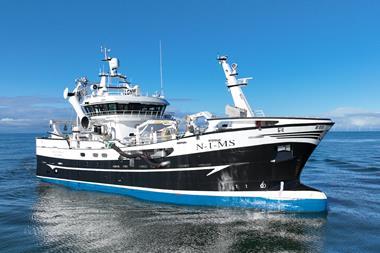
Among the European vessels that have opted for the version of Notus Echo tuned for nephrops is Swedish twin-rigger Glittfors, which last autumn had a sorting grid, command unit and hydrophone fitted on board, as well as computer receiving and displaying data.
“We installed Echo to see where we are catching nephrops. The Echo is becoming a very useful tool. We are finding the areas on our tow were there is more nephrops,” said skipper Thomas Anderson.
“We can also see when we are not catching anything and wasting fuel. We are very glad that the Echo sensor it is working very well."
Analysis of the Echo data indicate that nephrops congregate in hives, rather than being distributed evenly over fishing grounds. The Echo enables the skipper to locate these hives – the sweet spot and tow back over them. Echo also showed catch rates between hives can be almost nothing, making towing across those grounds a waste of fuel and time.
“The Echo is also showing good results in the UK for fishing nephrops. Sorting grids are not used there, so an acoustic pickup device was developed instead to produce the distinctive sounds of nephrops heading for the codend to be relayed to the wheelhouse,” Francis Parrott said.