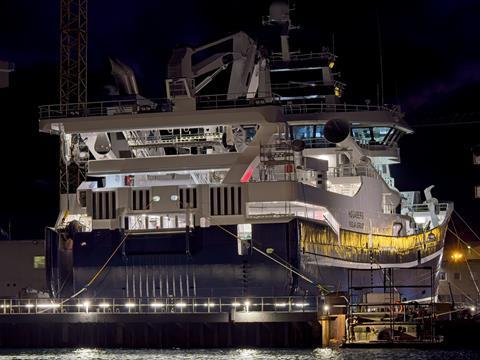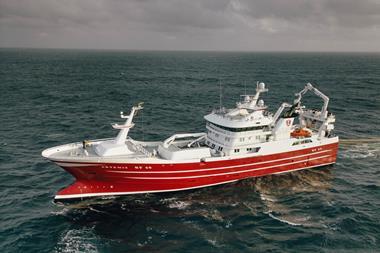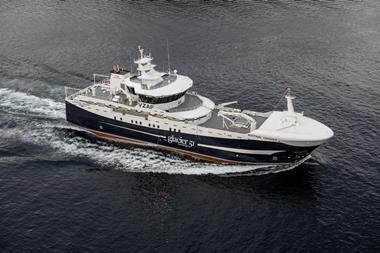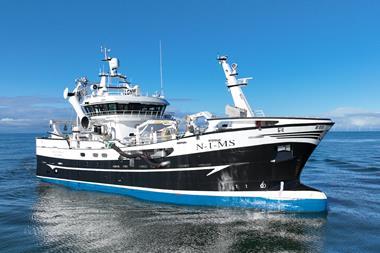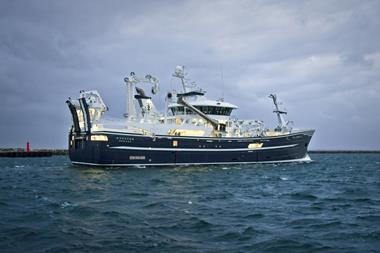





Built for Faroese fishing company Framherji, Høgaberg has joined the long series of pelagic vessels delivered by the Karstensen yard. Skipper Høgni Hansen took the new purser-trawler to start on blue whiting before making a first call in the Faroe Islands.
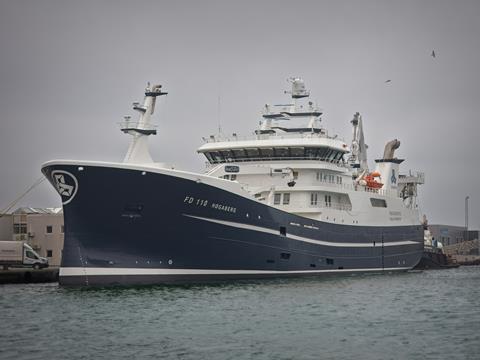
Høgaberg is the Karstensen’s own design, fine-tuned in co-operation with the owners, with the build completed at the yard in Skagen on a hull fabricated in Gdansk by the yard’s Polish subsidiary. Operating company Framherji also has pelagic vessel Fagraberg, as well as freezer trawler Akraberg and longliners Stapin and Jógvan 1.
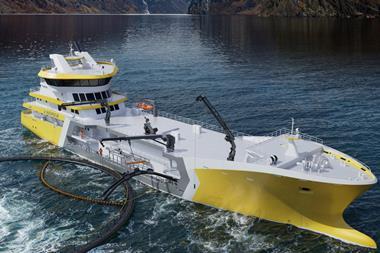
Designed as a pelagic trawler with capacity to switch to purse seining for specific fisheries, Høgaberg has an 87.8-metre overall length with a moulded breadth of 16.6 metres. Carrying capacity is 3,470 cubic metres in 15 RSW tanks, chilled by a triple 1300kW PTG FrioNordica RSW system. C-Flow supplied the vacuum system.
The focus is on optimising catch handling and storage, while keeping fuel consumption as efficient as possible – while also providing an exceptionally high standard of crew accommodation. Noise levels are minimised by placing accommodation areas as far as practical from the propeller. During sea trials noise levels proved to be well below the required and recommended levels.
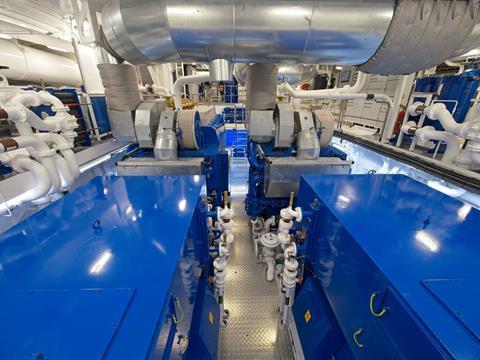
In a departure from the usual configuration, Høgaberg has twin main engines. These are twin 3600kW Bergen Diesel B33:45L6P units driving a 4500mm diameter Kongsberg KaMeWa CPP111A1 propeller via a Flender GVL-1400 reduction gearbox.
The energy system on has 2300 kW Cummins AvK shaft generators mounted in the front end of each of the main engines. Additional electrical power is sourced from the Caterpillar auxiliaries, a 940kWe C32 and a 565kWe C18. These are backed up by an 1100kWh Corvus Orca battery pack.
The power layout onboard is designed for the main engines to be the primary energy sources for both propulsion and the deck systems, with the shaft generators engaged while hauling. This works on the premise that when full power is needed for the winches, there is a reduced load on the propulsion system.
Its electrical power system is fitted for sliding frequency (60-50 Hz), by means of frequency converters for 400/440 V and UPS clean power static supply/converter for 230 V. This allows the main engine and propeller to be run at 17% lower revolutions that would otherwise be possible.
Tailored deck layout
Høgaberg’s owners opted for a deck layout with electric trawl and auxiliary winches from Evotec. The 118-tonne trawl winches are controlled by a Scantrol system. The trawl layout has a pair of 147-tonne net drums in a waterfall configuration, aligned with a hydraulic stern gate with hydraulic operated guide pins. There is a 69-tonne tail-end winch, a 20-tonne end-wire winch and a pair of netsounder winches mounted on the aft gallows.
Evotec also supplied the 40-tonne main and 15-tonne auxiliary purse winches, while the purse seine layout has been supplied by SeaQuest Systems, starting with a 40-tonne nethauler. The gear is routed back to the recessed net bin on the port side via the netstacker crane, plus there’s a floatline stacker and a telescopic leadline stacker.
An additional net crane on the aft gallows provides reach over any part of the aft deck.
The 4t/18m foredeck crane and the 3.5t/13m fish pump crane are also from SeaQuest, as are the three 20-inch electric fish pumps and the cable and hose reels.
Høgaberg’s wheelhouse is outfitted with electronics from Furuno, Simrad systems supplied by Radioservice and a Marport installation supplied by Vikmar.
The Furuno Smart Bridge System is at the centre of the wheelhouse array, with four 55-inch North Invent displays facing the two Nor-Sap 1600 skipper chairs. This allows the wheelhouse team to configure preferred sets of displays depending on the job in hand. In addition, there are a further 34 displays placed around the wheelhouse.
The heavyweight fishfinders are the 15-25kHz low-frequency FSV-25S, and 180kHz high-frequency FSV-75 sonars from Furuno, plus a 25kHz Simrad ST94 sonar, and the Simrad FS-70 trawl sonar. The sounders are Furuno FCV-38 and FCV-1900 units, complemented by a Simrad ES38 and a Simrad SN90 box scanner.
The current indicator is a Furuno CI68 and Marport supplied a full package of trawl sensors.
In addition to the Tecdis T-2128 system, the plotters are a pair of MaxSea Time Zero units. Radars, AIS, GPS and GPS compasses are all Furuno equipment, and the gyro compass and autopilot are from Simrad.
The Sat-TV, GMDSS A4 comms installation and the VHF sets are all from Sailor and the satellite communications are handled by a Starlink system.