




New technology, when it comes to sensor construction, battery technology and charging technology, has made it possible to develop distance sensors that can be programmed precisely to suit different conditions, and to create solutions that eliminate laborious operations, according to Scanmar.
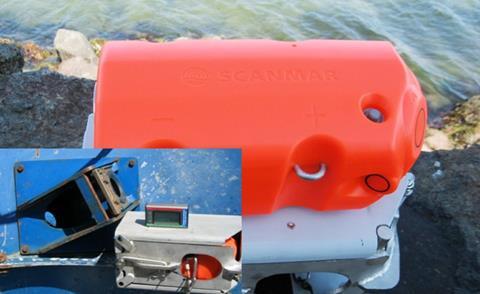
Norway-based Scanmar has developed three new variations of the Distance sensor based on the new SS4 technology, so that each fisherman can have exactly what he wants.
The most advanced of its new distance sensors has the following properties: several hundred working hours (varies with the setting); short charge time; charges while attached to the doors; programmable sending effect; programmable updating speed; multifunctional – can be combined with DoorAngle, Depth and other functions, either when acquired or later via the download of a license; programmable from the bridge, and; automatic programming of bridge unit and sensor.
Scanmar’s second Distance sensor is a simpler model that does not have direct connection to the bridge unit. It has a simple angle representation that gives control over the door angles, but not as detailed as a normal angle sensor. This model has upgrade functions.
The third unit is the simplest variation. It is described by the manufacturer as a direct replacement for previous distance sensors. It has large battery capacity and is quickly charged, but cannot be programmed.
According to Scanmar founder Henning Skjold-Larsen, the two last variations still represent a significant advancement on older generation bridge systems, such as the CGM, RX-400, C600 and 4000.
“When Scanmar introduced the Distance sensors more than 25 years ago, the battery technology was a big problem, and we chose two different updating speeds, which both were acceptable in order to not charge so often. What is interesting is that producers, who later have tested the market, have chosen the exact same updating, which confirms that the choice we made 25 years ago was not bad,” said Skjold-Larsen.
He explained all Scanmar’s new sensors are mounted on the doors in the same way as the angle sensors; they are mounted in holders that are welded directly on to the doors, parallel with the door, and not, as is commonplace, by cutting a hole into the door, even though this is more costly to produce because of the sensors’ construction, mainly because it demands two acoustic senders, one on each side.
“The advantages are first and foremost that the same sensors can be upgraded to also show the DoorAngles; as it is 100% required that the sensors be mounted on the doors’ vertical and horizontal direction. Besides, the sensor pockets will not stick out on the doors’ backside and thereby reduce the square force because of its affect on the current picture.”
Scanmar’s new series of Distance sensors have the same measurements and shape as the DoorAngle sensor, and use the same method of mounting – welded directly on to the doors.
According to Scanmar, the new one is far easier to install and is a necessity for correct Angle measurements if the sensor’s angle function is activated.