



Earlier this year, the South African based Irvin & Johnson purchased a pair of 8m2, 3400kg Polar Neptune trawl doors for their Sterkoder type, “Bluebell”.
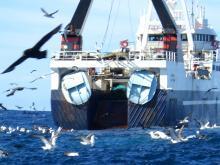
Irvin & Johnson fishing trawlers operate in various fishing depths, mostly from 200 to 800m. They fish for hake in bottom conditions from sandy bottom to hard rock bottom and in very heavy currents, when fishing in the Indian Ocean.
The Irvin & Johnson Sterkoder trawlers, “Boronia” and “Bluebell”, operate identical trawls with the same length of bridles, but different types of trawl doors. “Boronia” was using a fairly new model of doors but “Bluebell” was using an older model. When fishing in similar conditions, the average fuel consumption on daily basis on “Boronia” was around 10 tons compared to over 12 tons on “Bluebell”.
After the first trip with the Neptune doors, “Bluebell’s” average fuel consumption was less than nine tons per day, a difference of 30%. Both vessels fished in similar grounds in the same depth and current. “Bluebell” was using 3% less pitch on the propeller and towing on 3.9 knots, while “Boronia” was towing at 3.2 knots. During a four hour tow, “Bluebell” covered 2.8 miles more than “Boronia”.
One may ask, ‘how is it possible to reduce fuel consumption from 12 tons a day down to 9 tons a day, when it is general knowledge that in traditional demersal fishing, the trawl doors represent less than 20% of the total drag?’.
It is correct that trawl doors should represent less than 20% of demersal total drag, but if old and worn out trawl doors, forced into a greater angle of attack to achieve sufficient spread, are used, they can probably double the door’s fuel consumption.
Neptune doors have proven their performance with I&J. They have pruchased another pair of Neptune 8m2/3400kg doors for “Boronia” and a pair of Neptune 6m2/2400kg for “Forest Lily”.
During the first trip, “Boronia” showed reduced drag and further distance between doors than had been seen before. After 34 days of fishing, “Boronia” returned and had enough fuel left for three to four days of fishing. Normally, they are on the last few litres after 34 days of fishing. Fuel consumption on “Boronia” is down from nine tons to eight tons.
The Neptune doors on “Forest Lily” are also performing well, giving greater spread and more stability than previous doors.
Skipper Hlodver Haraldsson, fishing specialist of I&J says, “The Neptune doors’ spreading force and performance is excellent. The doors take spread immediately when shooting and are almost in full spread before they touch bottom. They are very stable and perform better than other doors in high current and difficult bottoms”.
“At first, we did not believe how little resistance they had. We tune them to sit very soft on the bottom to reduce resistance from the bottom contact though bridles are well shined. When using 200m bridles in deep water, we get 190-200m distance between doors and when fishing in shallow waters, we get 150-160m between doors. This is greater than before though we where using larger doors,” said Haraldsson.
Topics
Related Companies
- Previous
- Next