


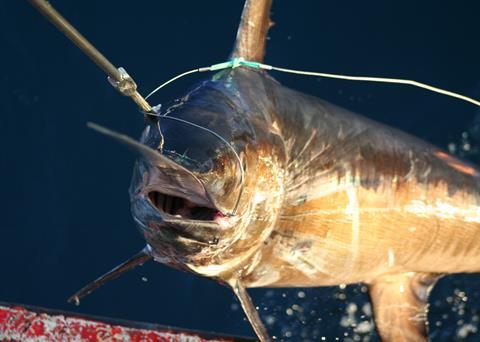
The North West Atlantic Canada swordfish pelagic longline fishery has been awarded Marine Stewardship Council (MSC) certification, and the US North Atlantic swordfish longline and buoy gear fishery has been entered into assessment.
Certification awarded
The Canadian swordfish fishery is active in waters off Nova Scotia and on the Grand Banks, inside and outside the Canadian EEZ.
Independent certifier Intertek Moody Marine (IMM) concluded the Canadian longline swordfish fishery meets the MSC standard because the stock is healthy and has been rebuilt from low levels in the early 1990’s. IMM also found that the swordfish fishery’s bycatch of sharks and turtles are within biological limits, and that the swordfish fishery is well managed with an annual quota for the fleet, Individual Transferrable Quotas (ITQs), size and gear restrictions.
“The successful completion of MSC certification makes Canada the first country to be able to offer its entire swordfish catch to the marketplace bearing the MSC ecolabel, the internationally recognised symbol of sustainability,” said Troy Atkinson of the Nova Scotia Swordfishermen’s Association. “As well, the Canadian longline fleet is the first pelagic longline fishery at the national level to have achieved the distinction of being certified as sustainable by the MSC and looks forward to making its catch available to customers that seek sustainably caught swordfish. MSC certification demonstrates the deep commitment of our swordfish industry and resource managers to the sustainable harvest and management of the swordfish resource.”
Improvements
IMM identified 11 improvement actions the swordfish fishery must resolve during certification, which lasts five years. The improvements address three principle areas of concern raised during assessment by the stakeholders and scientists involved: ICCAT and DFO management policies, impact on sharks, and impact on turtles.
Two improvement actions require the swordfish fishery to work with the Canadian Government to obtain clearer minimum guideposts for swordfish populations and harvest control rules from ICCAT.
Six of the 11 improvements are concerned with strategies to further minimise impacts on shortfin mako, porbeagle and blue sharks and on loggerhead turtles. The independent certifier’s scientific review team accepted an ICCAT assessment of blue shark that said: “Most models consistently predicted that blue shark stocks in the Atlantic are not overfished and that overfishing is not occurring” and the team similarly concluded the stock status of blue shark is healthy. However, the team also agreed with concerns raised by stakeholders around the management strategy of blue sharks and set a condition to address the concerns. The conditions on the certification have specific annual milestones that allow progress to be measured.
The swordfish fishery’s practices currently follow regulatory bycatch reduction/mitigation approaches for minimising turtle mortality, but the certification requires additional improvements that will further increase loggerhead turtle survival and reduce interaction under a new conservation plan implemented by DFO during the MSC assessment. Based on information from DFO considered in the assessment, turtle impacts have been determined by the independent certifier’s scientific team to be biologically acceptable because this impact is unlikely to harm the loggerhead turtle population recovery in the North West Atlantic.
The remaining three improvement actions require the fishery to work with the Canadian Government to obtain more scientific research on shark and turtle populations and to advocate for a more precautionary approach from ICCAT on directed fisheries and turtle and shark interactions.
Entered for assessment
The US North Atlantic swordfish longline and buoy gear fishery was entered into full Marine Stewardship Council assessment by Day Boat Seafood LLC of Lake Park, Florida.
Vessels fishing in the Southeast US North Atlantic portion of the fishery, which fish predominantly in the federal waters of the east coast of Florida, are currently certified. The new assessment will determine the sustainability of the US fishery in the North Atlantic and excludes the Caribbean and the Gulf of Mexico. This is the second MSC certification sought by Day Boat Seafood and, if certified, would offer a significant growth in the size of the US swordfish fishery covered in the MSC program over the currently certified fishery conducted by Day Boat Seafood in the Southeast US North Atlantic swordfish fishery.
The fishery entering assessment is located in the Northwest Atlantic Ocean, on the US east coast, FAO statistical area 31. The target species is the North Atlantic broadbill swordfish and is captured by pelagic longline (PLL) and handgear buoy line (HBL). The fishing season is year-round. In 2008, the PLL fishery landed 2,300mt and the HBL fishery landed 122,700lbs dressed weight (55.7mt). Currently, US fleets do not take the full total allowable catch for US vessels determined by the International Commission for the Conservation of Atlantic Tunas (ICCAT).
North Atlantic swordfish are managed as Atlantic Highly Migratory Species (HMS) under the dual authority of the Magnuson-Stevens Fishery Conservation and Management Act and the Atlantic Tunas Convention Act. The product is sold as fresh swordfish in the US.
Debbie Lewis, director of compliance and sustainability for Day Boat Seafood said: “Since last year’s MSC certification of our Southeast US North Atlantic swordfish fishery, we have anticipated expanding our sustainable fishing practices for swordfish to the rest of the US east coast. We are grateful to the stakeholders who continue to work with us to find sustainable solutions to commercial and environmental concerns.”