



Irish pelagic vessel Girl Stephanie
Karstensens Skibsværft have delivered the second of a pair of almost identical pelagic vessels for Irish owners that have the capacity to work either singly or as a pair team.
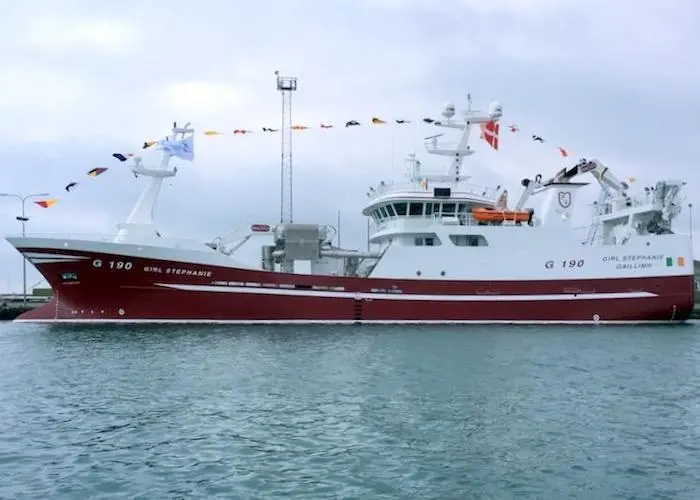
The 51.90 metre Girl Stephanie was delivered by the yard at the end of last year to its owners Stephanie Flaherty, Patricia, Tomás and Pauric Conneely, and it shares a design and much of its equipment with pair partner Western Chieftain, also delivered by the yard last year.
Girl Stephanie’s hull was built in Gdansk and towed to Skagen for fitting out. Delivery took place at the end of last year, in time for the new trawler to arrive in Killybegs before Christmas and to start fishing on mackerel in the New Year.
The previous Girl Stephanie, also built at the same yard, has been sold to Norway.
The Conneely family opted for a Rapp deck equipment package, with 60.50-tonne trawl winches controlled via a Rapp autotrawl, a 59.80-tonne topline winch and a 37.70-tonne tail-end winch. The two net drums have a 60.50-tonne pull. As well as the Rapp equipment, the owners also went for Irish-made equipment, with Sea Quest supplying the 5t/12m netstacker crane and the 4t/12m foredeck crane, as well as the 16-inch fish pump, reels for hydraulic and fish hoses, and the complete drive systems for the winches, cranes and associated equipment.
Catches are pumped to the eight RSW tanks that have a combined 851m3 capacity, chilled by a double Johnson Controls 375.000 kCal/hour RSW system with two 450m3/hour circulation pumps and two 160m3/hour condenser pumps. The RSW circulation system is fitted with remote operated RSW-valves with Lyng actuators. Iras supplied the vacuum system with two 2800 litre tanks and three 55kW compressor units.
Girl Stephanie’s main engine is a MAN 6L27/381 turning a Brunvoll 3600mm propeller via a Brunvoll gearbox with a 6.4:1 reduction and with a 1000kWe PTO-mounted shaft alternator. While towing, the alternator can be clutched out, with power supplied by one of the two Caterpillar C18s auxiliaries that can be connected to the main switchboard, controlled by the vessel’s DEIF Power-Management-System.
With the winches in use during hauling and shooting, the PTO can be clutched in to supply electric power, as while the winches are in use there is not expected to be the usual demand on the main engine, so it can be used as the primary power source for both propulsion and deck equipment.
Related Articles
 VESSELS & SHIPYARDS
 VESSELS & SHIPYARDS
 VESSELS & SHIPYARDS