



Fraserburgh twin-rigger breaks new ground
Three years of planning have gone into new twin-rigger Virtuous FR-253, delivered by Parkol Marine Engineering to father-and-son team Sandy and Alexander West who fish for prawns from Fraserburgh, reports Dave Moore.
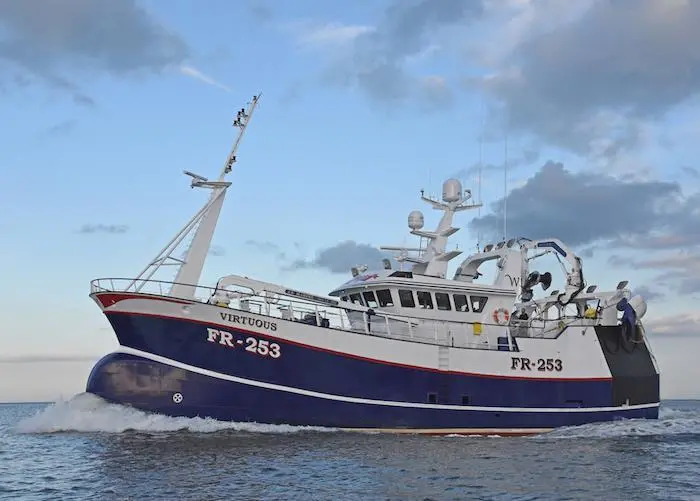
There’s a lot of shared history between the West family and Parkol, as the new trawler replaces the old Virtuous, which was completed by the same yard in 2010. Designed by Ian Paton of SC McAllister & Son, the new trawler incorporates some new thinking, as the owners were looking to make twin-rigging a safer and smoother process, getting away from the traditional method of bagging catches forward on the starboard side.
As this called for a way of handling catches aft while retaining the two sets of spit net drums aft, some new ideas were needed. Virtuous is designed with a stern ramp aft, located between the two gates facing the net drums, below the secure box for the centre clump weight and leading to a reception hatch aft of the wheelhouse.
“Although adapting to the new working arrangements represented a considerable learning curve, we were helped by the fact that they worked smoothly from the off when the anticipated benefits were immediately apparent,” Sandy West said.
“There is no doubt that fishing efficiency and safety have been significantly enhanced. Without the need to come round on the gear, the process of hauling is now continuous. In turn, this has reduced the time taken to shoot and haul. There are further time savings when moving grounds, as we can start steaming to the next selected position as soon as the gear is up, rather than having to lie until the codends.”
The forward section of the new trawler also departs from tradition, and the owners were interested in exploring the possibilities of new bow designs, leading to a prominent bulb that leans towards the inverted bow designs common in the offshore sector and increasingly with larger fishing vessels. The arrangement provides greater buoyancy forward, reducing slamming and consequently fuel consumption. According to Sandy West, Virtuous refused to slam at all during the heavy weather maiden trip.
“Virtuous handled some trying conditions well and immediately started to show her seakeeping capabilities. Early indications are that she will be an extremely comfortable sea boat, which was one of our main objectives,” he said.
“Although it’s early days, in my mind there is no doubt that the new style of bulbous bow is a major contributory factor to the first class seakeeping qualities we are now benefitting from. Full credit for this, together with the new aft bagging arrangements, goes to designer Ian Paton for applying divergent thinking to our initial requests and turning them in to reality.”
As well as the innovative bow arrangement, the full 7.80 metre breadth of the 24 metre LOA Virtuous is maintained virtually all the way to the transom to meet the needs of the new codend handling arrangements.
The trawler’s layout places the catch handling area forward under the weathertight shelterdeck, while the galley and mess area are also at main deck level, as is the winch room, located forward. Below main deck level there is a conventional layout with the forepeak, chain locker and thruster room forward, then the fishroom, engine room and cabin with eight deep bunks.
Mitsubishi power
Virtuous has a bank of four Mitsubishis in the engine room, supplied by Padmos. The 555kW S6R2 T2-MPTK-3 main engine is solely for propulsion, driving a Reintjes WAF 474 gearbox at a 7.476:1 reduction to turn a 2500mm diameter four-bladed propeller and modern high-thrust, low-drag nozzle, designed by Ian Paton.
A 335 kW Mitsubishi S6B3 variable-speed auxiliary engine mounted on the port tank top powers the deck machinery hydraulics through a JBJ splitter box driving two Kawasaki load-sensing 115kW pumps. An electrically driven 45kW power pack is used to drive a load-sensing hydraulic towing pump, as well as provide back-up hydraulic power. This arrangement also enables the deck machinery to be operated in harbour without the need to run the main engine. Electrical power on board is supplied by a pair of 105kW Mitsubishi 6D16T auxiliaries driving 125kVA Newage Stamford 415/3/50 generators.
Cooling for all four engines and the hydraulic system is provided through NRF box coolers arranged across the forward end of the engine room. Sea chests, valves and associated pipework are protected from mussel growth by a Sonihull ultrasonic generator supplied by NRG Marine. This generates bursts of ultrasonic energy in multiple frequencies, to create a pattern of alternating positive and negative pressure to cause cavitation the result of which is a micro jet action that cleans the underwater part of the hull and prevents the build-up of single cell organisms such as algae.
Split winches
Instead of the standard three-drum winch for twin-rigging, Sandy and Alexander West opted for three split trawl winches, located in the forward winch room. The deck equipment package is supplied by EK Marine, which designed and fitted the full hydraulic setup.
The trio of two-speed trawl winches have a 15-tonne core pull and carry 275 fathoms of 22mm warp on each drum, as well as a further 50 fathoms of 28mm backing wire. Port and starboard warps lead over the shelterdeck top to hanging blocks on the aft gantry, while the middle warp runs slightly offset to starboard under the wheelhouse floor before leading upwards and over a roller built into the gantry to the secure box for the clump.
The split trawl winches are operated from a control panel built in to the fishing console in the wheelhouse, from where there is full sight of the trawl doors and clump coming up to the blocks.
While towing, the outer wires are chained up to a free running slewing block on a short strop attached to swivel blocks mounted on the trawl gantry. The middle wire is worked directly off the winch drum, allowing the skipper to adjust warp length depending on the spread data from the Simrad TV80 trawl monitoring system.
Two sets of double 15-tonne split net drums are arranged side by side on the quarter in line with the transom shooting and hauling hatches, the lower edges of which are fitted with large-diameter rollers. EK Marine provided the 1.5t/7m kinked boom crane fitted with a Thistle 24in W-sheave powerblock on the trawl gantry. Codends are brought up the stern ramp by a 7-tonne gilson.
Catches are sorted on an elongated sorting table where the crew select whitefish and prawns into baskets. Sorted and gutted fish and tailed prawns are washed and dropped down to the fishroom for weighing and labelling on the Marel M2200 scales, with data logged onto the wheelhouse computer. The fishroom has a working capacity for approximately 1000 boxes and 6 tonnes of flake ice can be held in two ice lockers, each fed by a Ziegra TW 1250 machine. Premier Refrigeration of Fraserburgh fitted chilling to both the forward and aft bulkheads, as well as the deck head.
Electronics
Virtuous has an array of mainly Simrad electronics supplied, installed and commissioned by Echomaster Marine, with a combination of 17-, 22- and 24-inch Neovo X-Series flat screens flush mounted in the main and overhead forward consoles, and aft at the trawl console with its view over the trawl deck, and flanked by CCTV displays of activity on the quarter, forward at the split trawl winches and from the top of the aft mast. In addition to the 14 CCTV cameras on board, there is also a hull-mounted camera overlooking the propeller, nozzle and rudder. An additional display screen is also positioned at the central desk area in the wheelhouse for recording fish weighs, using the e-log, weather services and general internet use.
The main console is arranged on a single level forward of two NorSap NS1500 skippers seats that flank a central island console. A Simrad twin-rig double distance net monitoring system provides gear spread and fuel economy data and the three Simrad PZ sensors provide constant numerical and graphical updates of the middle clump’s position in relation to the trawl doors. The door sensors provide twin net spread and pitch/roll data, while the clump sensor provides depth and water temperature measurement.
The fishfinder is a Simrad ES80 split beam echo sounder with 38kHz split beam and 200kHz single beam transducers. Position data is fed to the Olex 3D plotter with ground discrimination, and two Sodena Easywin plotters which support a combination of Tide T8 charts, AIS and ARPA tracking.
Related Articles
 PROCESSING & REFRIGERATION
 VESSELS & SHIPYARDS
 VESSELS & SHIPYARDS