



First of shrimper pair from Vigo yard
The CNP Freire shipyard in Vigo has completed the first of a pair of Rolls-Royce factory trawlers designed to catch and process shrimp for owners in Greenland.
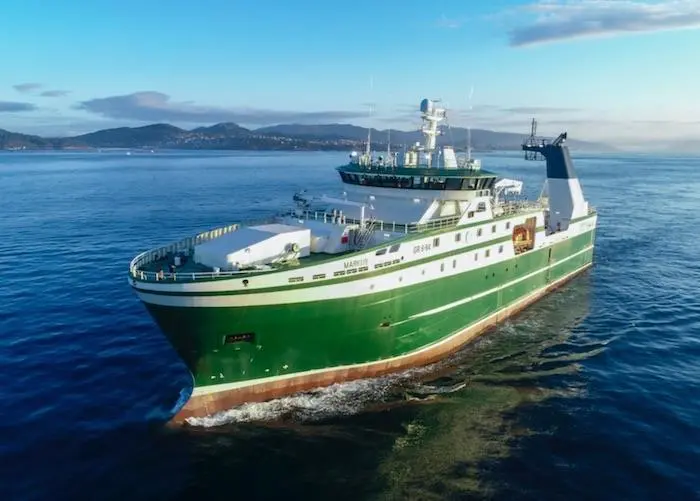
Markus was delivered in February by the Freire yard, where the naming ceremony was held and the new trawler was christened by its Godmother Rhea Helimann in Greenlandic national dress.
The new Markus is the first of the two factory trawlers built at Freire for Qajaq Trawl and Polar Seafood, and the yard has a history of building sophisticated fishing vessels for owners in the Nordic region to fish in Arctic waters.
Markus and its sister vessel due for delivery shortly both feature a high level of automation and are optimised for high fuel efficiency and low emissions, as well as for good seakeeping qualities and the comfort and safety of the crew. Built to an NVC375 design, the main dimensions of the pair are 80.80 metres LOA, with a 17 metre beam and a depth to the main deck of 10.60 metres. The refrigerated fishroom measures 2265m3 and the processing deck with four IQF belt freezers can handle approximately 100 tones of shrimp over a 21 hour period and the two automatic horizontal plate freezers can process approximately 25 tonnes per 24 hours. Tank capacities on board are for 248m3 of MDO, 683m3 of HFO and 81 tonnes of fresh water.
The Rolls-Royce is prominent on board Markus, having not only provided the design package, but also a great deal of the equipment.
“Rolls-Royce has a long history working with both Qajaq Trawl and Polar Seafood in designing several fishing vessels for use in a harsh climate. We are of course very happy to continue this co-operation,” said Rolls-Royce’s VP Sales-Marine Monrad Hide.
In addition to ship design, the equipment package includes engines, propulsion system, automation, winches, steering gear and a power electric system.
Both Markus and its sister vessel are each powered by a 5400kW nine-cylinder Bergen B33:45L9P, a high-efficiency engine developed by Rolls-Royce and demonstrating its capacity to deliver 20% more power per cylinder compared to its predecessor. This lowers the costs through the engine’s lifecycle, and allows for smaller engine spaces on board.
Markus also has a 3300 PTI/PTO shaft generator, 1843kW Bergen Diesel C25:33 and 910kW Mitsubishi S12R-MPTAW-4 auxiliary engines, and a 250kW Volvo Penta D13MG emergency set.
The propulsion systems of both vessels are completed by a Promas installation that integrates the propeller, a hubcap, rudder bulb and the rudder itself into a single hydrodynamic efficient unit. A Hybrid Shaft Generator (HSG) is also installed. This is an advanced power electrical system that enables a highly flexible use of engine and propeller speed variations to maximise both propeller and engine efficiencies, which again helps to reduce exhaust CO2 and NOx emissions.
Bow thrusters are 750kW TT1850 units, also from Rolls-Royce, which also supplied the package of low pressure hydraulic main winches with electrically driven auxiliary winches. In bad weather the dynamic winches keep the trawl gear in the best position to fish efficiently and reduce wear on the equipment.
The Freire yard is currently completing the second trawler for owners in Greenland, and also has a new marine research vessel for the Belgian government under construction – also a Rolls-Royce design plus an order for a 77 metre tuna purse seiner for the Calvo Group in Spain.
Related Articles
 PROCESSING & REFRIGERATION
 VESSELS & SHIPYARDS
 VESSELS & SHIPYARDS