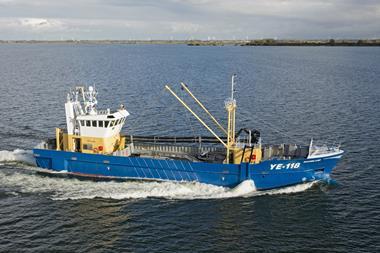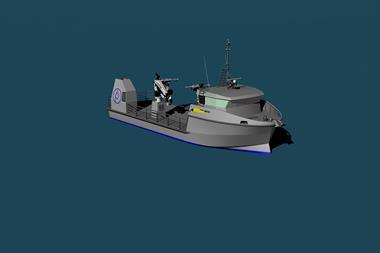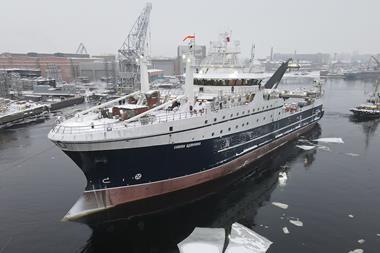


Scientific research vessel ‘Tridens’ has been delivered, following an extensive refit at Damen Maaskant Shipyards Stellendam in the Netherlands.
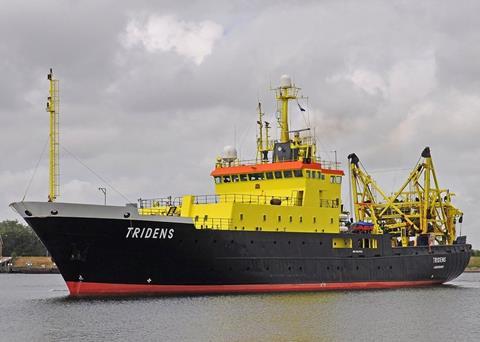
The vessel – operated by Dutch governmental shipping company Rijksrederij (part of the Dutch Ministry of Infrastructure and Environment, Rijkswaterstaat) - underwent a major midlife conversion to boost the vessel’s multifunctional capabilities for fisheries research, including installation of an innovative drop keel.
The Rijksrederij is the custodian of the North Sea and manages a fleet of specialist vessels. The maritime research institute IMARES, in collaboration with other European fisheries institutes, employs Tridens to help determine fish stocks in the North Sea, among other duties. The vessel is 73.5m in length, with a beam of 14m.
Looking to increase efficiency in employing the 25-year-old Tridens, the Rijksrederij developed a high-tech engineering package together with Damen Research, Damen Maaskant Shipyards Stellendam and GNE BV Hardinxveld-Giessendam.
“We’ve worked with Damen Maaskant Shipyards Stellendam over many years for maintenance, but this is the first time we’ve completed a refit of this scale and the first time we’ve installed a drop keel,” says Dirk Kuijt, technical manager at the Rijksrederij.
Scientific equipment
During the refit, Tridens was fitted with a wide range of modern scientific research equipment, including the innovative drop keel with broadband multibeam echosounder installed by IJmuiden-based WNL Marine Electronics. With the new equipment, Tridens can accurately track biomass and fish shoals in the ocean, as well as conduct bathymetric surveys.
Deployed up to 3m proud of the hull, the drop keel eliminates interference from the air bubbles that normally form around the hull and can affect the performance of the echosounders.
Installing the drop keel had far-reaching consequences for the rest of the vessel, requiring extensive engineering of the ship’s design and layout in order to accommodate the trunk – a kind of elevator shaft in which the drop keel is lowered.
The drop keel’s specialised engineering works lasted 27 days, but making Tridens future-proof for another 10 years of demanding mobilisations required a complete refit and modernisation.
This part of the project saw Damen refurbish cabins for the crew, and overhaul the main engines, all propulsion equipment and the steering apparatus. The refit included completely replacing the stern gantry and winches and maintenance of the stern mast, booms, A-frame and the corners of the stern of the vessel. In addition, a dedicated device was developed for safe hauling of otter boards.