


Norway’s Kongsberg Discovery has strengthened its EK80 echo-sounder product range with wide-band low-frequency capability, which it says will enable its customers across governments, academia and industry to gain a much more detailed picture of the ocean environment than has previously been possible, amid an increasing focus on sustainable management of the oceans.
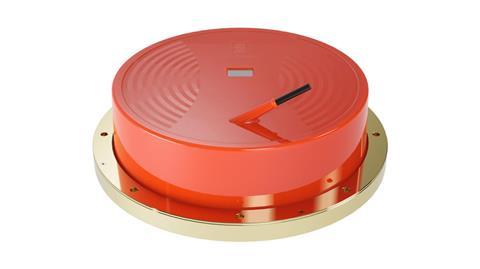
EK80 products are part of Kongsberg’s portfolio of monitoring and measuring tools and is used for all types of ocean research. They have historically been used primarily for biomass assessments, but the instruments are seeing increased adoption for other biological, physical and chemical oceanography applications.
An EK80 vessel-mounted system typically comprises six transducers operating at different sound frequency spectra, matched with transceivers, software and planning tools. The transducers are calibrated to give highly accurate, quantitative metric values of application targets.
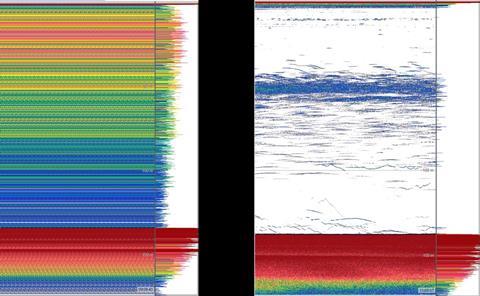
Kongsberg Discovery’s new ES18-11 MK2 transducer widens the operational frequency spectrum of its existing ES18 split-beam transducer from 18 kHz to at least 14 to 22 kHz, increasing the resolution of the data as well as providing more information for target identification from this frequency band.
The development project also led to an improvement in transducer element design reducing the challenge with ringing, which mean that the transducer can be used for both shallow and deep-water measurements.
“The ES18-11 MK2 further enhances the EK80’s overall performance and brings us one step closer to uncovering the mystery of the oceans. It is an important innovation that we are certain will contribute to increasing knowledge of ocean biology, physics and chemistry, in line with UN SDG-14 Life Below Water,” said Lars Andersen, VP Ocean Science at Kongsberg Discovery.
The core application of ESI8-11 MK2 remains the identification of biological targets. The 18 kHz transducer is already common on most research vessels, but the wider bandwidth of ES18-11 MK2 can reveal the much richer biological diversity actually present, the company said.
Findings can be used to fingerprint what species are present, and thus uncover components of the food chain in that area.
“Any fish stock that is commercially fished must have a management plan, and the MS18-11 MK2 will help to generate more holistic ecosystem assessments so that authorities can make better stock management decisions,” Andersen said.
Understanding life in the water column is also key for environmental impact studies, for example in offshore wind-park development where EK80s already have been deployed to collect ecosystem data in Europe and the US.
Mesopelagic research
Understanding ocean ecosystems in the mesopelagic zone (roughly from 200 to 1,000 metres), home to the planet’s largest biomass of fish and marine organisms, is a growing field in oceanography and ocean management.
According to Kongsberg, with its expanded frequency, the ES18-11 MK2 can be used to quantify marine life through the entire water column, divulging size and quantity of targets in the “ocean twilight zone”. It added that increased understanding of the mesopelagic ecosystem is essential to govern potential future harvesting of what is effectively the largest unexploited resource left in the world’s oceans, with a recent global biomass estimate of around 10 billion tonnes.
The ES18-11 MK2 can detect and quantify the interface between water masses, enabling improved detection and mapping of oceanographic layers (stratification), and changes in water salinity and temperature. This can help researchers understand, for example, how the ocean absorbs CO2 and to monitor climate change impacts.
In addition to physical sampling, mapping water masses can also contribute to understanding the dynamic mixing of warm- and cold-water fronts in the oceans and its effects on ocean gyres (circulation).