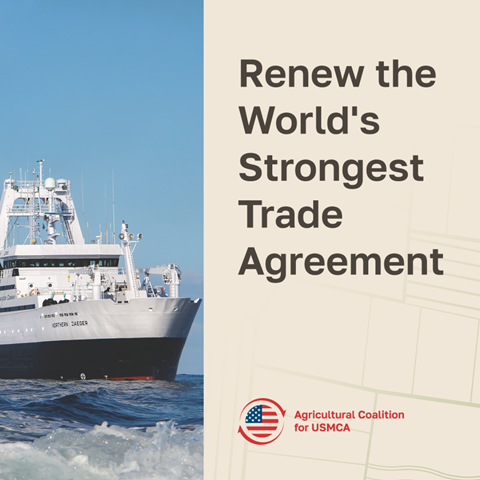





The US seafood industry has joined a broad new push to safeguard the United States-Mexico-Canada Agreement (USMCA), with the National Fisheries Institute (NFI) helping to launch the Agricultural Coalition for USMCA.
Announced on 5 February 2026, the coalition brings together food and agricultural trade associations from across the US supply chain, underlining the economic importance of tariff-free trade with Canada and Mexico at a time of renewed global trade uncertainty.
According to economic modelling cited by the coalition, agricultural and seafood exports to Canada and Mexico generated US$149 billion in total economic contributions to the US economy in 2024 alone, supporting nearly 500,000 jobs and $36 billion in wages. Since USMCA came into force in 2020, the value of US agricultural exports to the two neighbouring markets has increased by $20 billion, reaching $60 billion in 2024. Seafood exports accounted for $1.2 billion of that total.
NFI said the agreement has been particularly critical for seafood trade, which depends on predictable access to key export markets. In testimony to the Office of the United States Trade Representative (USTR) in December, Morgan Bell, NFI’s director of public policy, described USMCA as a cornerstone of industry stability.
“Under this agreement, tri-national seafood trade has thrived, benefiting US seafood suppliers, their employees, and the millions of consumers they serve,” Bell told the USTR hearing.
He also pointed to strong growth in bilateral trade flows since the agreement’s entry into force. US seafood exports to Mexico have risen by 65%, while exports to Canada are up 17% over the same period.
“In a volatile global trade environment, stability matters,” Bell said. “A predictable, tariff-free framework gives our members confidence to innovate, plan, and compete.”
The formation of the Agricultural Coalition for USMCA comes as US trade policy faces renewed scrutiny ahead of the agreement’s next review phase. For seafood companies, which rely heavily on cross-border processing, distribution and export markets, any disruption to North American trade flows could have immediate impacts.
By aligning with agricultural producers and processors more broadly, NFI said the seafood sector aims to ensure that USMCA remains a durable foundation for regional trade – and a platform for continued growth across fisheries, aquaculture and value-added seafood products.