


Per Funch-Nielsen, managing director of O.W. Icebunker Ltd., explains to Peter O''Neill how his company supplies vital fuel and provision to fishing vessels in some of the toughest conditions in the world.
From the Flemish Cape in the west to Novaya Zemlya in the east and as far south as 30 deg north, you will find some tough and skilled seamen at work on board floating fuel service stations. Their job is to make sure their customers in the international fishing fleets are kept on the go. These stations provide vessels with all their needs from fuel, drums of luboil, spare parts, ancillary equipment, provisions and even a change of crew.
We caught up with Per while he was travelling to Kaliningrad and St Petersburg to meet clients. Icebunker is part of the O.W. Bunker group which also supplies bunkering services around other parts of the world to ports in countries like Sweden (Stockholm), United Kingdom (London), Germany (Hamburg), Latvia (Riga), Estonia (Tallinn), Lithuania (Klaipeda), Greece (Pireaus), Singapore (Singapore), China (Hong Kong), South Africa (Cape Town), Netherlands (Rotterdam), Turkey (Istanbul) and Belgium (Antwerpen). Of course there are typhoons and cyclones to contend with in the Far East but the fierce seas of the northern hemisphere and the long cold months are a more constant field of risk. It is no accident that Icebunker have pictures of icebergs on their website.
As these northern waters were once the working fiefdom of the enormous Soviet fleets which have fallen on bad times since market capitalism came to town, World Fishing asked whether the bunkering business was picking up with the remnants of the fleet.
"The fleets now have a five-year quota system so this has made it possible for them to get long-term financing and so they are in the market for new equipment and services so they can come back to their fishing grounds. Things are picking up. But of course the cost of bunkering has also gone up with fuel price increases and that is putting pressure on other prices -- with rises of 20% to 30 %. With that kind of margin it is difficult to make weak fish prices cover the difference.
"As for the effect of prices on Icebunker, we just follow the oil prices market. What is the case, is that some vessels, from whatever fleets, may just stay in port longer. There has been talk of converting some of these vessels to run on fuel oil instead of diesel to try to meet costs, but that all depends on whether their existing engines can be converted."
Pipe to pipe
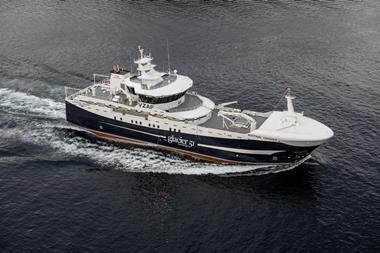
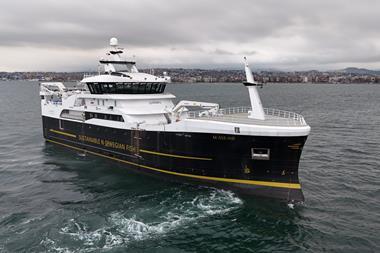
But let us return to northern waters. As I talked to Per there were four positions showing on his website for Icebunker Barges -- and they are positions which you can hear every night on the BBC Shipping forecast with more than the odd storm or gale warning: the M/T Kotlas was riding in the Norwegian Sea / Rockall, the M/T Vidnoe was in the Norwegian Sea (NEZ) / Bear Island, the M/T Olivia was at the Flemish Cap / Nafo area and then the Irminger Sea / Denmark Strait.
"These operations can involve serious risks so the tanker crew have to be very experienced to ensure maximum safety a smooth supply operation. Often the crew's abilities are tested and almost taken to the limit in the rough weather conditions, freezing cold winds and high seas in the North Atlantic," he says.
"When the captain of the tanker gets an order from the main office in Aalborg, Denmark, to supply a trawler, he will contact the client and they will agree on a rendezvous position. The two captains will then decide if it is safe to carry out the supply operation.
"The stern bunkering operation will commence with the two vessels slowly approach each other and, after the towing line (it can be up to 200 metres long) has been secured, the vessels will proceed together at a manoeuvring speed of a minimum of two knots. This operation can be extremely dangerous in a high sea, because the receiving vessel can accidentally cross the towing line, jam the screw or rudder and leave the vessel unable to manoeuvre.
"All being well, with the towing line secured and the vessels sailing along together, the bunkering hose will be sent out from the tanker and picked up and connected to the manifold at the receiving vessel. When secured, pumping begins. A blind flange prevents water getting into the hose. After bunkering the hose is emptied (blown through with compressed air) and this prevents any oil spillage into the sea.
Dinghy to vessel
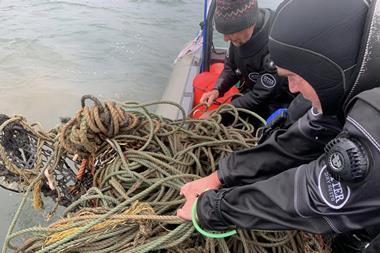
"Supplies of lubes, provisions etc. are made by the tankers crew using a dinghy. Again this can sometimes be a very dangerous operation. The dinghy, jumping up and down of course, lies in the water alongside the tanker and supplies are lowered into it by the tanker's crane. Then, usually with two crew, it sails over to the client boat to make sure they get their delivery. This can mean many trips between the two vessels. It is the tanker captain who decides whether the weather is suitable to carry out supply operations.
"For fishermen it is good to know that the floating service station will be around on a regular basis. Reliable arrival times are very important because trawlers have often discharged/transhipped their fish cargo to a transport vessels and need the bunkers supplies immediately to maintain stability."
Black eyes to the rescue!
he experience and skill of the O.W. Icebunker Ltd. tanker crews in the North Atlantic also means that they are often in demand for special jobs such as rescues or retrieving scientific buoys.
"In June 2004 we were asked by the JRCC, Halifax, to assist a capsized sailing yacht whose sole sailor was trapped inside the boat," recounts Per. "It took 14 hours in very bad weather, with gale force winds and high seas, when, just before sunset, the tanker located the capsized yacht which had lost its keel. Volunteer crew members, dressed in survival suits, launched a lifeboat and they sailed off to rescue the trapped sailor. During the rescue operation the lifeboat lost is own rudder and power and started to fill with water. Yet, despite the risk to their own lives, the tanker crew got the sailor out and brought him onboard the tanker. The bruises and black eyes of the rescue crew were clear testament that this had been a very dangerous operation!"
"Therefore, we are proud of our men -- the most important asset in the services of our bunker operations on the high seas of the North Atlantic -- they are indeed the brave crew of the supply tankers. Thanks to their skills and experience we can easily say: "So few are doing so much for so many".
There have been new developments in warmer southern waters. Icebunker's sister company O.W. Bunker in the Malta office has signed a cooperation agreement with Greek Supplier Seka S.A.. Since January last year O.W. Bunker Malta Ltd. Has been supplying all grades of marine fuels and marine gas oil (MGO) at Kali Limenes port in Greece.
"The Kali Limenes bunkering station offers ex-pipe bunkering at three available docks in a sheltered bay, approximately seven miles from international merchant shipping routes. There are two fuel oil and two MGO onshore tankers in the station, complemented by in-situ blending facilities.
"O.W. uses the same barge to re-supply the shore installation which allows to minimize the costs and to offer the customers a barge service at no additional cost. We therefore advise that three to four days notice is recommended to guarantee supplies by barge, although we can always arrange for ex-wharf supplies on a short notice.
"Regardless of their size and draft, vessels operating in the East-West Mediterranean shipping routes will have an access to supply of bunkers by barges at a well protected anchorage, just a few miles off the installation, and most importantly, almost without any deviation or waiting time."
Another partner in the group shows the synergies of modern logistics. Wrist Shipping A/S, headquarterd in Aalborg provides a long list of services including agency chartering , stevedoring, extensive port agency services, forwarding, ship management, offshore supply, containers, trucks and liner service, ship management, crewing, technical support and spare parts, deliveries, crew change etc. when passing through Danish waters, air freight, Lloyd's Agency, a variety of marine surveys
Per says "O.W. Bunker offers our customers expertise in three main business areas: bunkering, oil cargo supplies and risk management. We have more than 20 years of experience in world-wide bunker services and that is why we now have subsidiaries in 14 countries."
Per adds "We maintain a steady flow of bunkers and we have never missed a single customer order due to bunker shortages. Our office staff, on-line with the fleet 24 hours a day, is ready to serve you and your vessels anytime, anywhere, with time-saving supplies at competitive prices." The only thing is that I do not expect to bump into him at the petrol station while filling my car -- certainly not the one off Rockall!