


The Granville Bay whelk fishery has become the first whelk fishery worldwide to enter Marine Stewardship Council (MSC) certification.
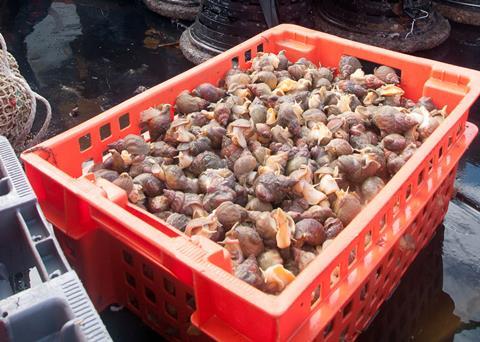
In the decade from 1970 to 1980, whelk consumption and production grew considerably, which caused the resource to become endangered. In 1985, the industry started to adopt a policy to restore the whelk stock.
Daniel Lefèvre, CRPM-BN chairman explains: “Thanks to intensive cooperation between the Regional Fishing Board, the Syndicat Mixte pour l’Equipement du Littoral (SMEL), IFREMER, the University of Caen and Normandie Fraîcheur Mer (NFM), we were able to improve the acquisition of biological data and define technical measures that could contribute to restoring the fishery.”
Arnaud Manner, head of Normandie Fraîcheur Mer (NFM), the association of fishing industries in Lower-Normandy, steered a pre-assessment of Granville Bay whelk fishery in 2008: “This pre-assessment allowed us to establish a more efficient application and to estimate the impact of the regulatory measures taken such as a maximum length of 12 metres for vessels, a maximum of 720 baited pots allowed per vessel, the minimum catching size of whelks, a limited fishing period and less licences granted.”
Laurence Mace from SMEL, responsible for the scientific monitoring of the whelk fishery, alongside the CRPM-BN, confirms that the measures show positive trends: "The number of whelk kilograms landed per trap increased from an average of just under 1kg in 2009 to nearly 1.5kg in 2013; while at the same time, the market size of whelks sold increased!”