Four months after the tsunamis and earthquake that shook Chile, on 27 February, the four-month old government has presented several master plans to rebuild the country’s fishing industry, writes Ian Emmett, from Constitución, Chile.

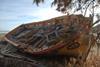
Fishing boat Dama del Mar was swept up onto land, in Constitución's fishing bay, Maguillines. There she remains to this day.

Fishing boat Dama del Mar was swept up onto land, in Constitución's fishing bay, Maguillines. There she remains to this day.

The first of these strategies, ‘Back to Sea’, involves the government funding up to 25% of costs for replacing or repairing boats up to 12 metres, engines and fishing gear, for a maximum amount of CLP 2.1 million (€3,122/$3,910) per beneficiary.

Neither fishermen nor shipowners will actually receive cash as this will be channelled directly to the private supplier companies concerned.

To finance the remaining 75%, soft credits are being made available, with the guarantee of the Chilean economic development agency, Corfo. Fifty percent of this 75% comes from the private sector, namely from the copper mining industry, so that the fishermen only have to finance the remaining 25%.

Emergency works already busily underway cover the period 2010-2012, while reconstruction works, which are also underway, cover the period 2010-2014.

‘Lets Build Chile’ is a project designed to reactivate the fishing industry in the coastal areas most affected by the earthquake and tsunami, with a total investment of $110 million (€87.8 million), a figure including the $26 million (€20.7 million) funding of return to school, as infrastructures have been damaged or destroyed.

Huge catch shortfall

One month after the disaster, industrial fishing companies had reported a 50% fall in catch figures, March normally being the best month in the year. In terms of volume, this meant catching 300,000 tonnes less.

Forecasts for 2010 as a whole, according to the Association of Industrial Fishing Companies (ASIPES) chairman, Luis Felipe Moncada, point to a 60% fall when taking into account damage to processing plants and a 56% decrease in landings, during the first quarter, in the VIII Region (Bío-bío) in central-southern Chile.

Dichato, in the Bío-bío region, an artisanal fishing port and tourist resort, scrubbed off the map by the tsunami, ranks among the worst hit coastal areas.

It is scheduled to have an 800 metre “mitigation park” overlooking the beach, with restaurants. This area will protect the housing to be built 80 metres behind the high tide line, to replace the 1,400 houses destroyed by the tsunami. An innovation for the artisanal fishermen in this bay will be a marina with a landing pier for water-sport activities.

Talcahuano, where fishing vessels and the Asmar shipyard, processing plants, landing piers and the town itself were severely damaged or destroyed, is scheduled to have its port, La Poza, rebuilt.

The rebuilt port will be designed as the “main access window” to the sea while being linked to the town itself, as it is one of the major driving forces in the local economy.

To avoid containers hurtling onto the town’s main road, as occurred on 27 February, a new 50-hectare area outside of town will be reclaimed from the sea. Part of the $700 million (€558.6 million) investment will also cover constructing a 2km road, from the Interport Route leading into the new port, designed to keep lorries out of the town area.

The region’s governess is looking for foreign investment to take part in this reconstruction plan that will cover the period 2010-2014.

Rebuilding infrastructure

In central Chile, in the Maule Region, a tourism-orientated project is already in full swing, known as the ‘Fishing Bay Route’.

With private sector funding from Antofagasta Minerals (Amsa), a copper mining company in northern Chile, a total investment of CLP 3.2 billion (€4.8 million/$6 million) is being channelled into five coastal towns in this region – Boyeruca, Duao, Loanco, Pelluhue and Curanipe – to form a maritime fishing tourism route, with the appropriate infrastructures.

These include building roads, accommodation for tourists and road signposting.

The 160km covered by this initiative is only one of the stages involved in rebuilding production infrastructures for seaboard towns and villages in this central region. Work has already begun on recovering warehouses, offices and fisheries guild premises, in 13 fishing bays in the Maule Region.

Reinforced cement cubicles are mainly being installed for storing boats and engines. A further CLP 1.2 billion (€1.8 million/$2.2 million) is being invested to donate new boats and engines to fishermen.

Rebuilding the production infrastructure for these 13 fishing bays – Boyeruca, Llico, Duao, La Pesca, Trinchera, Putú, Río, Maule, Maguillines, Pelures, Loanco, Pelluhue, Coranipe and Cardonal – will be completed in August, coinciding with the start of works on the “Fishing Bay Route”. In coordination with Sernatur, the Chilean tourist office, the idea is to link this route up with other tourist routes to boost the economy.