




Pangasius is no longer the dominant force in the Vietnamese fish export trade. This is due to adverse publicity in European countries which has resulted in poor sales, and a lack of investment capital in Vietnam which has seen independent farmers forced out of business.
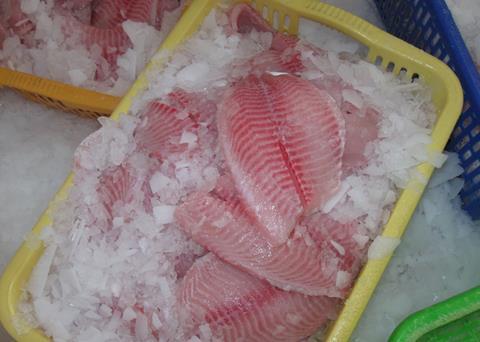
Tilapia is farmed in cages in the Rivers Hau and Tien, the main branches of the Mekong River. Both red tilapia (Orechromis niloticus) and black tilapia (Tilapia mossambicus) are grown in about equal quantities and, like pangasius, are mostly exported in fillet form.
According to local media, Vietnam’s tilapia exports have enjoyed strong growth during the past decade, increasing from an export value of $1.95 million in 2004 to more than $32.2 million in 2014.
In 2014, Vietnam exported tilapia to more than 60 countries, according to official sources. The USA was the key market, importing 1745 tonnes valued at $5.24 million, and accounting for 18.2% of exports, followed by Spain with imports valued at $3.7 million and Colombia with imports valued at $3.03 million. The remaining top 10 importers were the Netherlands, Belgium, Germany, Mexico, the UK, the Czech Republic and Italy.
Pangasius decline
The farming of pangasius has been in decline for several years. This is due to the strict loan policy of the Vietnamese banks whereby farmers face interest rates of up to 30% if they require capital to buy feed and juveniles in advance.
So, many private farming operations have been forced to stop producing pangasius for processing and export. Now the trade is dominated by processors who own their own farms and are able to pre-finance the farming effort out of their cash flow systems.
Unfortunately, as with pangasius, there is a shortage of funds for investing in tilapia production in Vietnam which means there is not enough fish for the industry to fulfill its export potential.
Ten years ago, the Vietnamese government began implementing a project to develop tilapia as a key aquatic export. However, output has not expanded as anticipated and hasn’t kept pace with domestic demand.
Moreover, international marketing efforts have stagnated as the industry, fraught with raw material shortages, simply isn’t in any position to make or keep large foreign commitments.