



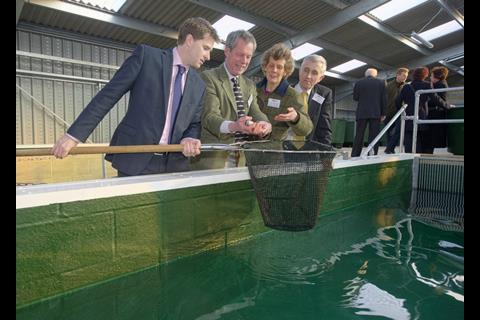
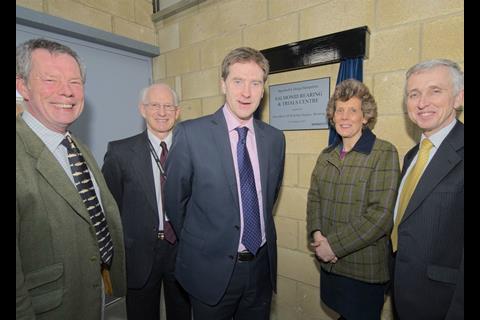
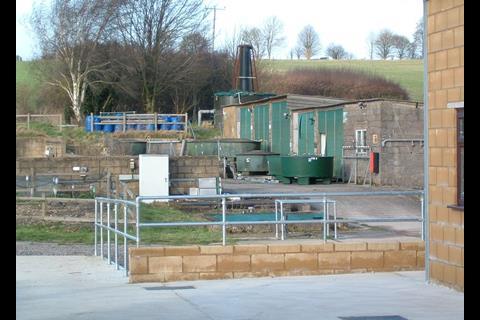

The UK’s Sparsholt agricultural college, has opened a new £500,000 Salmonid Rearing and Trials Centre – a unique teaching and research centre that aims to help bolster the UK''s aquaculture industry.
The new 1003m3 facility is part funded by the European Fisheries Fund (EFF) and the Marine Management Organisation (MMO) as part of the five year £38m project aimed at creating a UK fisheries sector that is more profitable and more sustainable.
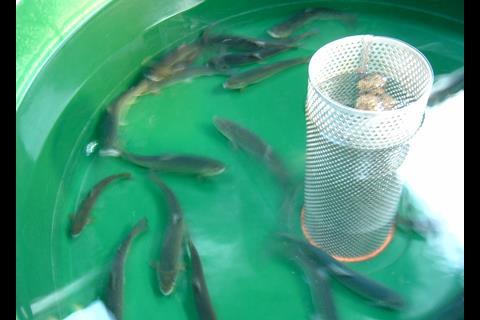
The new facility will centre around rearing both rainbow and brown trout for research at present – but in the near future it also hopes to conduct trials with arctic char.
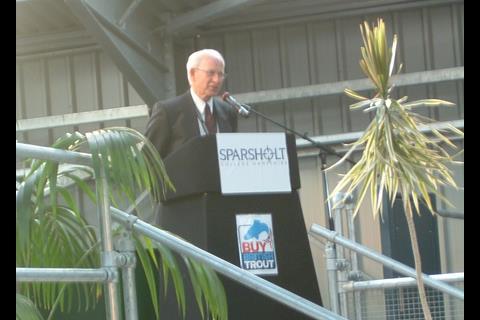
Robert Hughes, UK trout sales manager, for global aquaculture feeds producer, Skretting, and Steve Brine, MP for Winchester & Chandlers Ford, opened the facility on Thursday 31 January. The company has a long history with Sparsholt when it comes to working together in fish nutritional research.
At the same time as the opening, the college also launched a new Fish Husbandry Apprenticeship – a brand new qualification which has been developed with Lantra, the UK’s Sector Skills Council for land-based and environmental industries.
Although education is a fundamental part of the new facility, it has significant potential as a research facility. Feed trials are currently underway for Skretting - which is not only of benefit to the company but also means that students can get precious on the job aquaculture training while completing their theses.
Adrian Love, fisheries studies, Sparsholt College, told World Fishing & Aquaculture that several trials are underway at the moment. He said: “We are involved with other novel trials that involve fat content analysis of fish feed and some third year students are currently completing a theses on fish feed pellet colour to see if that could be an advantage to rearing."
And it doesn't stop at research, the facility will also support some local fisheries’ re-stocking programmes and sell small quantities of ‘Sparsholt Trout’ on to staff and local markets in order to minimise wastage.
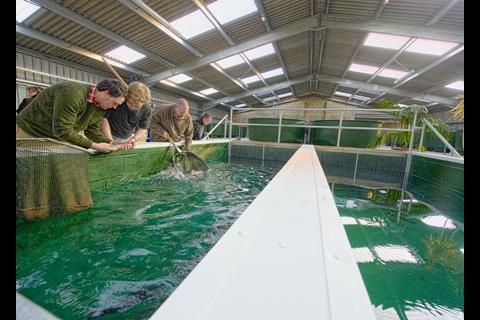
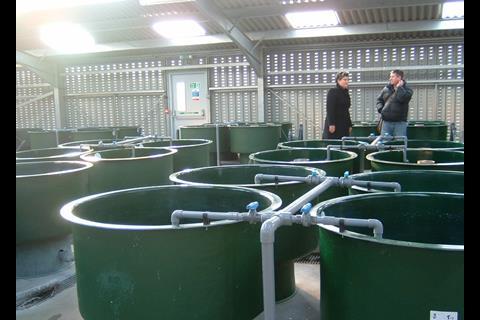
The rearing room has a multitude of interchangeable rearing tanks of different sizes keeping the facility as flexible as possible. This is important for when the need arises to work on a multitude of different projects at the same time. Next door is a small sterile unit, yet to be completed, where tests and small scale processing can be performed. There is also an adjacent classroom.
At the other end of the rearing room is the hatchery which houses four units, with 12 shelves each, each capable of holding around 30,000 fry. Here the fry are nurtured until they are large enough to be moved into the rearing room.
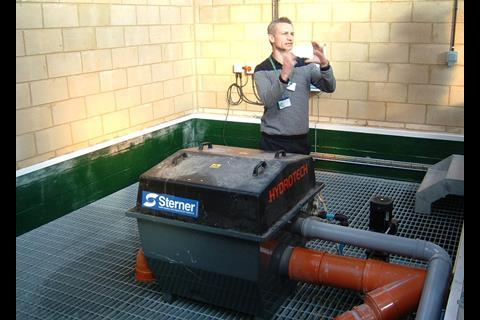
The facility itself is fed by water from two nearby boreholes with ground water that stays at a fairly constant temperature of 11°C - perfect for rearing. At the heart of the facility is a Sterner Hydro Tech water filtration system which maintains high water quality. It’s all a bit of a step up from the original facility which was built in the 1970s by the students - the new facility should enable the college to make its own mark on aquaculture research and train up tomorrow's specialists in the field.
For more information on the new facility or the college’s new Fish Husbandry Apprenticeship scheme visit: www.sparsholt.ac.uk