



Sustainability is the buzz-word in today’s seafood industry. To most people it refers to fishing practices designed to ensure that fish stocks are constantly being renewed and remain at a level where there will always be sufficient fish available for the future.
The Marine Stewardship Council is probably the most high profile of many so-called environmental groups which purport to safeguard fish stocks. “Our vision is for the world’s oceans to be teeming with life – today, tomorrow, and for generations to come,” it says.
However, to the owner of a seafood restaurant on the outskirts of Weymouth, in the south west of England, sustainability means much more than that. The menu at the Crab House Café in Wyke Regis changes daily, sometimes twice a day, depending on what locally caught fish and shellfish are available.
And ‘local’ means that all the fish and shellfish served in the restaurant or bistro are caught that day within a 40 mile (64km) radius. “Regular boats land to us,” says Crab House Café owner Nigel Bloxham, “plus we use the markets (Weymouth, Poole and Brixham) as back up – but again we only buy from certain boats.
“We use what swims in the [English] Channel. We buy from English fishermen on English boats and that way we benefit the English economy.”
So, for Mr Bloxham sustainability refers as much to providing local fishermen with an income and providing money for the local economy, as it does to protecting local wild fish stocks.
But sustainability doesn’t start and end with fish. The bread served in the restaurant comes from a local baker and the Crab House Café’s own label ale and stout are brewed locally; even one of the sparkling wines on the wine list comes from a winery very close by. “By doing this we are sustaining the local community,” says Mr Bloxham.
Vegetables and herbs are grown in a greenhouse and garden behind the restaurant and for the future Mr Bloxham is going to forage for ingredients and is looking for local sites to farm seaweeds. “Seaweeds are so much better for you than spinach which we hear a lot about,” he says.
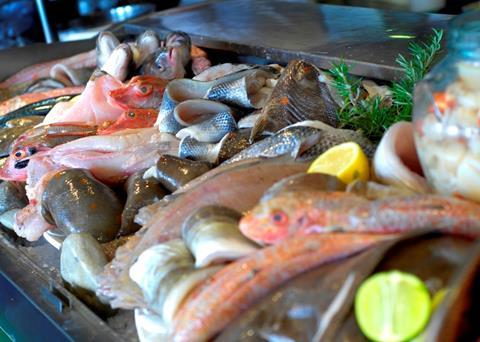
There are normally about six species of fish on offer in the restaurant and they are displayed on a fishmonger’s type slab in full view of diners.
Although he trained as a chef, Mr Bloxhan has been involved with seafood for more than 30 years. His first venture was supplying fresh fish from the market of his home town of Brixham to caterers including Keith Floyd who was probably the UK’s first ‘celebrity’ seafood chef.
Mr Bloxham then started a business, Sea Fare International, producing and selling marinated shellfish, mainly cephalopods, again to caterers before competition from Asia became too severe and he had to stop. He then got the opportunity to buy an oyster farming business which included a café on its land.
This building, which included oyster storage tanks, has been transformed into the Crab House Café and has acquired a worldwide reputation. “People from all over the world come to eat here,” Mr Bloxham says. “I never dreamt it would be so successful.”
Sustainability obviously pays.