



A computer programme that has been designed by a South African company to capture, store and summarise commercial fishing information, has found an application in Australia where the South East Trawl Fishing Industry Association (SEFTIA) is using the software as the basis of its ''E-Boat'' project.
E-Boat involves the trial and development of the software, known as Olfish Trawl, for the purpose of replacing the paper logbook system and thereby reducing the cost and effort of fisheries compliance.
Olfish Trawl allows trawler crews to transmit vital catch information while still at sea, thereby generating important information for the use of the fishing industry, marketing bodies, research organisations and environmental groups.
According to SEFTIA member, Lachlan Marshal, who was quoted in the Association's newsletter, the electronic logbook has the capacity to not only reduce the amount of time associated with compliance, but dramatically change Australia's approach to research and knowledge of marine resources.
"Currently all fishing operators must fill out paper log books while at sea for catch data, research and compliance, which then has to be lodged electronically with the Australian Fisheries Management Authority (AFMA)," he said. "This new technology will not only collect more detailed and accurate data, but it will be substantially less time consuming. The crew will still fill out the normal log book, but then e-mail this data directly from the trawler via satellite-link."
Mr Marshall said the inclusion of additional information such as depth, moon phases, latitude, longitude and weather conditions would vastly improve the detail of the existing logbooks with the added advantage of real-time accuracy.
Olfish Trawl was developed by the South African fisheries consultancy, Olrac which is headed by doctors Amos Barkai and Mike Bergh. Dr Barkai has been intricately involved in the Australian E-Boat project. He says that Olfish Trawl is capable of recording an entire trawl fishing operation, including vast amounts of information on fishing gear use, environmental conditions and detailed information about the type of fish that are caught. It nevertheless has a very simple user interface and is easy to operate.
Dr Barkai emphasised that the software may be customised to suit the needs of individual fishing companies and skippers:
"Users have the freedom to input data at any level of resolution: per drag, per day or per trip," he said.
The system's report writer enables users to generate a report from the raw data. The reports include calculated data which were not entered by the user; for example, catch-per-unit-effort (cpue).
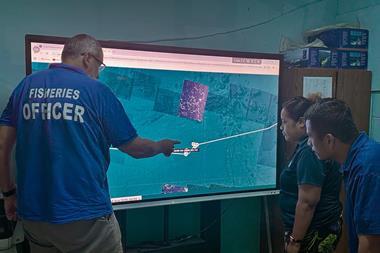
Olfish Trawl also includes a sophisticated Global Information Systems (GIS) tool which enables users to plot a variety of data (such as catch effort, cpue and sea conditions) on a real time geographical map. It also includes a year planner which gives the user an annual summary of the fleet activity, such as fishing and non-fishing days, on a calendar-like display.
While the Australian fishing industry appears to have perceived the advantages of Olfish Trawl, the South African industry has been slower to take advantage of the product. According to Dr Barkai, South Africa's biggest trawling company, I&J will experiment with the software early in 2002 and Sea Harvest, the country's second largest whitefish producer, has demonstrated interest in the product.
Olfish Trawl is presently in use in New Zealand and there has been keen interest in the software in the UK, Sweden and Denmark.
A new version of the software, that will be suitable for use on board longline vessels, will be available early in 2002.