






Shakespeare’s new VHF antenna health checker
The new ART-3 antenna radio tester from Shakespeare Electronic Products Group offers a cost-effective method of ensuring the radio and antenna are performing to their best efficiency, according to the US-headquartered company.
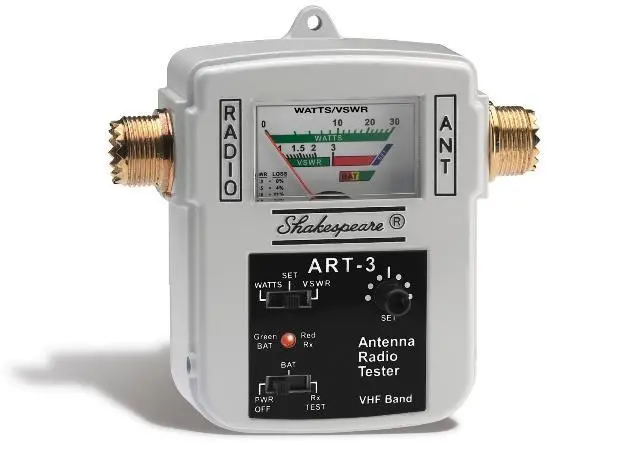
The Shakespeare ART-3 tests radio output power, antenna VSWR (efficiency) and receiver functionality. It displays RF output power up to 30 watts on an easy-to-read, built-in scale. It has an internal battery or can be connected to the onboard 12V DC power supply.
A boat’s VHF antenna is one of the vital links in the communication chain onboard, Shakespeare said. Regular inspection and testing are easy steps owners can take toward ensuring this important equipment performs properly when needed.
Before every trip on the water, Shakespeare advised the radio system should be tested. A simple method is to make a series of transmissions to another boat, from a range of known distances on a non-emergency channel. Both boats can then assess the quality of each other’s transmissions.
Performing a solo test starts with tuning in a distant VHF weather station. After disconnecting the antenna at the radio, the signal should weaken or disappear. Reinserting just the tip of the coax connector should produce a signal that will improve as it is fully reconnected.
If instead the signal disappears, there may be problems with the connector or antenna. Likewise, if wiggling the connector causes large changes in signal strength, its connection to the cable itself may be faulty.
More accurate and sophisticated testing comes with the help of a meter that measures system performance.
“Having a good backup plan in place is also important in the event of an antenna failure or accident. Carrying an emergency antenna provides the reassurance and security for such a situation. The Shakespeare 5911 and SL156 emergency antennas each offer a solution; both are compact and easily stowed,” the company said.
Related Articles
 FISHING TECHNOLOGY
 FISHING TECHNOLOGY
 COMMENT