



Global seafood trade growth
Seafood is the most globally-traded animal protein with a trade value of US$164 billion last year, according to the latest seafood trade map and report compiled by Rabobank.
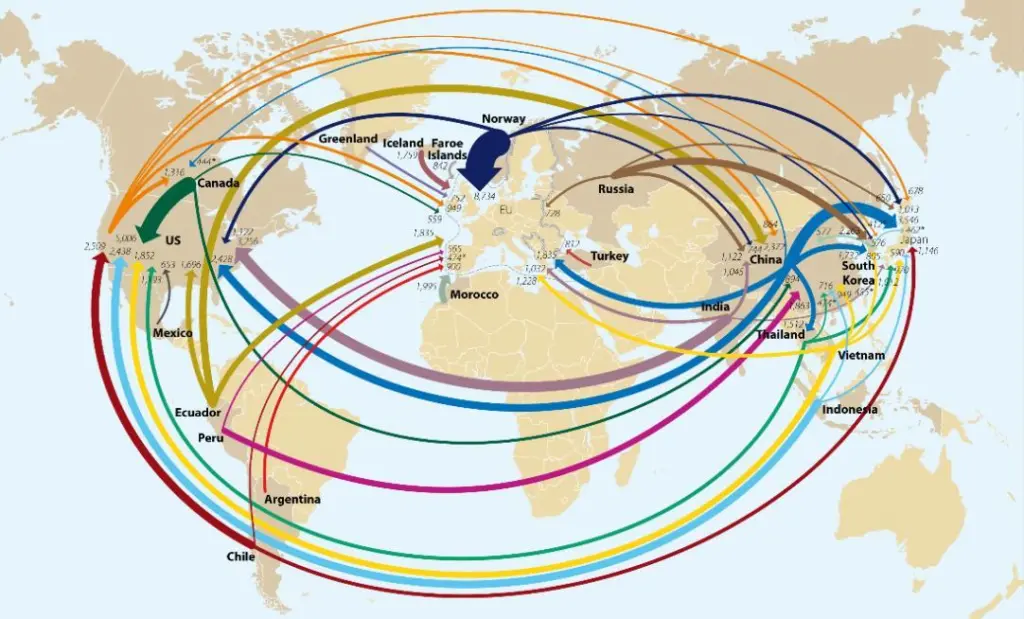
Plotting the increased demand for fishery and aquaculture products, Rabobank’s 2021 World Seafood Map finds that close to half of last year’s trade flowed to the EU, the United States and China – with the markets’ combined imports exceeding $80 billion.
At the same time, Rabobank confirms that the overall seafood trade was roughly 3.6 times the size of beef trade in 2021, five times the size of global pork trade, and eight times that of the poultry trade.
It also establishes that there were more than 55 trade flows each valued at over $400 million a year and an additional 19 trade flows were valued at between $200 and $400 million each.
“Developing countries play a major role in seafood exports, accounting for seven of the top 10 exporters, and developed countries are increasingly reliant on developing nations for imports of high-value species, especially shrimp from India and Ecuador and salmonids from Chile,” Rabobank Seafood Analyst, Novel Sharma, said.
Largely comprising farmed salmon, the trade from Norway to the EU-27+UK continued to be the most valuable flow, valued at over $8.7 billion. Following in second place was the trade from Canada to the United States, valued at $5 billion, and then $3.3 billion worth of seafood from India to the United States.
The EU-27+UK continues to be the world’s largest seafood buyer by value, importing products worth over $34 billion (last year, while US seafood imports totalled $28.1 billion, and China with $17.2 billion worth of imports.
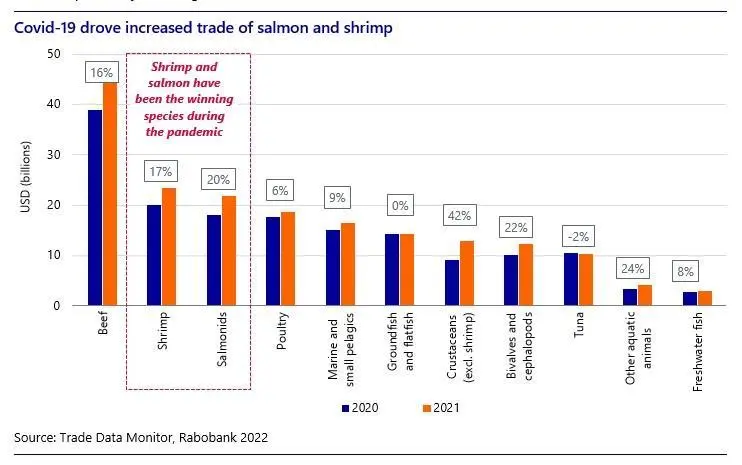
Rabobank’s analysis also concludes that the COVID-19 pandemic further strengthened the already high demand for high-value species such as shrimp and salmonids.
“During the pandemic, we saw higher-value proteins such as beef, shrimp, and salmonids outperform other proteins, with year-on-year growth in trade value of 16 percent, 17 percent, and 20 percent, respectively,” Rabobank Senior Seafood Analyst, Gorjan Nikolik, said. “We are also seeing unprecedented high prices for many seafood species due to challenges in international trade such as rising freight and energy costs and continued lockdowns in China.”
Both analysts reckon the demand for sustainable and healthy seafood will continue to drive trade volumes of high-value species over the next few years.