





SEAC to build brand new machines
SEAC, which until recently had concentrated on completely renovating/rebuilding processing machines for small fish, is now designing and building brand new ones.
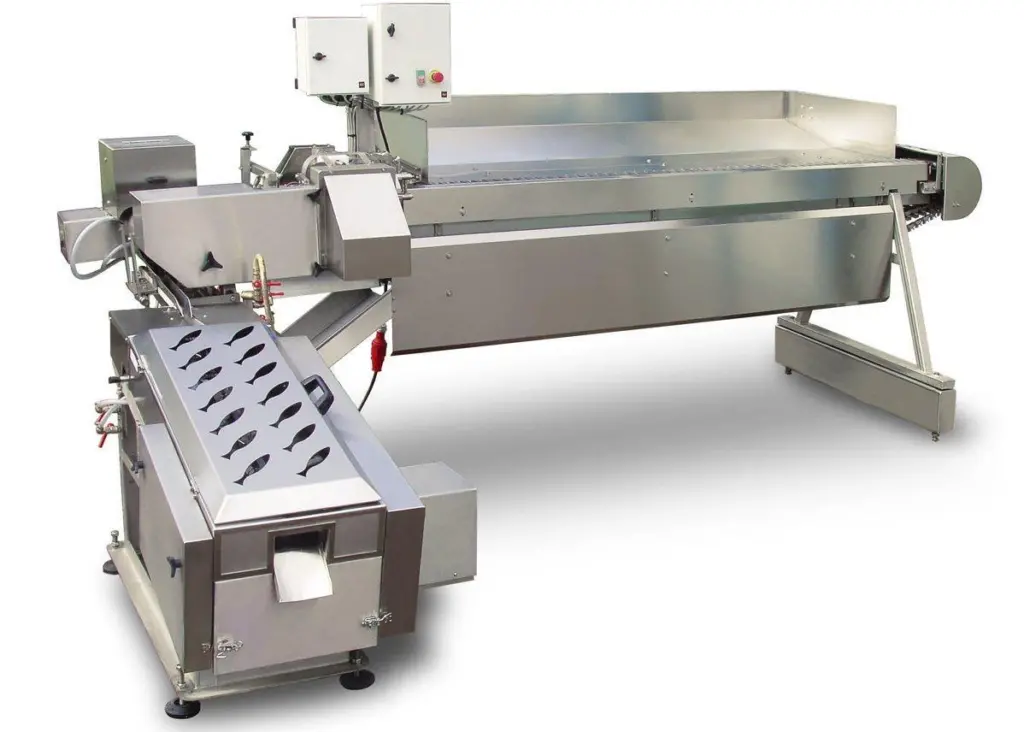
“After 20 years we ran out of second hand machines [the company used to renovate/rebuild former Arenco models],” says Ulf Groenqvist, president of the Swedish company, “and therefore started developing our own new fish processing machines for small [pelagic] fish. However, we are still renovating old machines when we can find them.”
Four types of new high capacity machines have so far been built – the FPM-100 and 200 for nobbing (removing the head), and the FPM-300 and 400 for both nobbing and filleting. All except the FPM-100 are based on former Arenco machines.
SEAC exhibited its FPM-200 nobbing machine at Seafood Processing Europe (SPE) in Brussels at the end of April 2012 and will have the FPM-400 nobbing and filleting machine, the latest model to be developed, on display at SPE this year.
The new models have been well received, according to SEAC. “So far, we have delivered 12 brand new FPM machines,” says Mr Groenqvist, “three FPM-400 nobbing and filleting machines, four FPM-100 nobbing machines and five FPM -200 nobbing machines. These have been sold mainly inside Europe, but one FPM-100 is now on its way to the Far East.
“On the FPM-200 nobbing machine we can process fish smaller than 70 fish per kg, while the FPM-300 and FPM-400 filleting machines can go down to approximately 50 fish per kg – even smaller but there is no economy in this.”
The SEAC FPM-100 was originally designed for use at sea handling up to 100 fish per minute using two operators, but it has now been modified for use also on land and can process pelagic fish of different sizes and types at up to 400 per minute.
“It is completely different to the FPM-200/400 as it uses only vacuum,” says Mr Groenqvist. “There is no measuring device or tail cutting unit and it has a plastic conveyor belt instead of stainless steel pockets. But this is a very price worthy machine.”
SEAC’s new generation machines can fillet fish weighing down to approximately 10g at a capacity of up to 250 fish per minute using four operators.
“The main processing machines on the market today – VMK and BAADER – are not well suited for fish smaller than approximately 25-30 fish per kg and this is where our newly designed machines take over,” Mr Groenqvist says. “It took us about three years to go from 25-50 fish per kg, but only about six months to do the next step – under 50 fish per kg – and we were very surprised when we did a bigger test on defrosted IQF Baltic herring from 20 to even under 10g [per fish].
“However, what was even more surprising was that we could fillet sprats from Abba Seafood that had been in a bucket in our refrigerator for two years. It was amazing.”
Related Articles
 PROCESSING & REFRIGERATION
 SEAFOOD
 SEAFOOD