





Russia could significantly increase crab production this year
Russia may significantly increase its volume of crab production this year, with the aim of boosting supplies to the domestic market, according to recent statements by some leading Russian crab producers and senior officials at the Federal Fisheries Agency, reports Eugene Gerden.
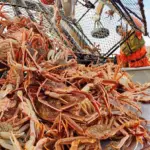
As part of these plans, a particular attention will be paid for the increase of production of Kamchatka (king) crab, which is the most valuable crab species found in Russian waters. Currently the annual catch is estimated at about 6000 tonnes. However, the government, together with fishing companies, plan to increase this figure to 25,000 tonnes by 2020.
In recent years there have been significant increases in crab landings in Russia, mainly due to TAC increases. The catch increase has been approved by the Federal Fisheries Agency on the basis of recommendations provided by the All-Russian Research Institute of Fisheries and Oceanography (VNIRO).
Last year the total Russian crab catch amounted to approximately 65,000 tonnes and there is a possibility this year production may grow by about 25%. In comparison, in 2015 crab production in Russia amounted to 56,700 tonnes, while in 2010-2011, these figures were below 30,000 tonnes.
The most important commercial stock of Kamchatka crab from Western Kamchatka is currently on the rise, while, in addition to Kamchatka crab, the range of major crab species produced in Russia includes blue crab, snow crab, and tanner crab.
In the meantime, leading Russian analysts in the field of fish business and producers believe planned 25% increase of production should result in a decline in crab prices in Russia by 25-30%. Currently prices for crab meat in Russia are varied in the range of RUB3000-4000 (US$60-70), which makes the product unaffordable for the majority of local population.
Due to this, the majority (90%) of crab, caught in Russia, is exported, with the US, South Korea and China as the major markets for Russian crab exports.
According to the Federal Fisheries Agency’s analysts, in addition to high prices, a lack of wholesalers in Russia and gaps in logistics, this is the reason for a lack of crab and seafood.
“There are not even wholesalers who would ensure the supply of crab to shops and restaurants, this is done by fishermen themselves, and they do not have a great deal of experience in this,” said Alexander Duplyakov, president of the Russian Association of Far Eastern Crab Producers which represents leading Russian crab producers.
The current high prices for crab in the local market can be explained by the restrictions on crab fishing that were in force several years ago. These restrictions were imposed by the state during the 2000s and were mostly triggered by large-scale poaching activities in the Russian crab industry in 1990s in the wake of the collapse of the USSR. This led to the loss of almost entire crab stock in Russia at that period of time.
Planned reform
There is a planned increase of crab fishing in Russia and further development of the country’s crab industry may be complicated by the recently proposed large-scale reform of the industry.
A recent initiative for the extensive reform of the Russian crab industry was put forward by the Russian Federal Security Service and some prominent businessman, who reportedly have links to Russian President Vladimir Putin.
Currently the quotas on crab catch in Russia are distributed on the basis of historical principle, which means in practise that they are usually granted for a few market players, with the lack of real competition.
The latest 10-year quotas for crab in Russia were approved in 2008 and will expire later this year. These quotas take into account the history of fishing for the previous period. A new application period for quotas for the next 15 years began in April this year.
However, there is possibility such a campaign will not be started, as Putin may replace the current historical principle of quotas’ distribution by the system of auctions.
Putin was also asked by the businessman to exclude crab from the list of resources for which quotas can be obtained under the investment quotas mechanism, conditional on building new vessels at domestic shipyards. Those behind the initiative do not believe that crab production in Russia will create conditions for the development of high-tech shipbuilding.
The change of the existing scheme of crab quotas distribution may be within the interests of the wealthy Rotenberg family, which receives the majority of state contracts for the implementation of large-scale infrastructure projects. According to Russian industry analysts, members of the Rotenberg family are named on the sanctions lists of the EU and the US, which limits their investment opportunities.
Russian media also reported the reform may be of interest to the Russian Fishing Company (RRPK), which is owned by Gleb Frank, the son-in-law of Gennady Timchenko, another Russian billionaire close to Putin.
Related Articles
 FISHERIES
 FISHERIES
 WORLD FISHING EVENTS