




Robotic gliders enhance ocean survey work
The Scottish Association for Marine Science (SAMS) has reached a major milestone, gathering the equivalent of five years of oceanographic data using robotic underwater Seagliders.
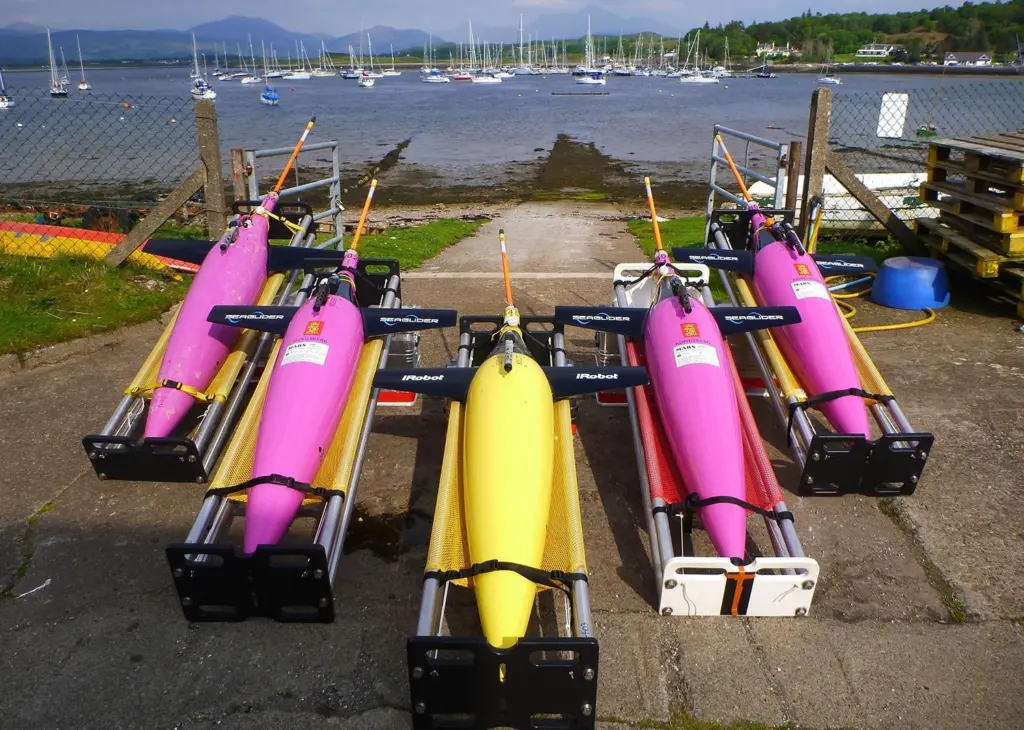
The 6ft Seagliders can spend months at sea collecting data, representing a major change in how marine scientists collect information on climate change including sea temperature, salinity, pressure and oxygen.
“Seagliders allow oceanographers to make cost-effective, long-term, and long-distance observations, often in hard-to-access regions that ships rarely frequent and other ocean robots rarely go,” said Dr Stefan Gary, a research associate in physical oceanography, SAMS.
Seagliders collect data down to 1,000m as they slowly submerge towards the seabed and then rise to the surface, using fixed wings and a hydrodynamic shape to create a forward movement. To submerge, a battery-powered pump moves oil in a pressurised container, increasing the density of the glider in the water and causing it to sink. To bring the glider back to the surface, oil is pumped back into a bladder to increase buoyancy. Live data is sent by thee gliders via satellite to the pilots at SAMS, who can control and re-direct them remotely in near real-time.
“Because of their durability we often deploy them in the winter, as they have been known to withstand extreme storm-force conditions. Seagliders also allow for very dense sampling of the ocean, collecting a profile every three kilometres, while a survey vessel usually samples every 10 to 30 kilometres,” Dr Gary added.
To date, the seven Seagliders have spent the equivalent of five years at sea, travelling more than 33,000km. Last week saw one Seaglider, Ardbeg break a SAMS distance record by completing a round-trip of more than 3,400km along the Extended Ellett Line, a route from Scotland to Iceland that has been surveyed by scientists for 40 years.
SAMS owns two Seagliders, bought back in 2009 and 2011, and has operated another five from the Natural Environment Research Council’s (NERC) Marine Autonomous and Robotic System (MARS) instrument pool since April 2014. SAMS, which is ideally situated for deep-sea Atlantic research, runs the Scottish Marine Robotics Facility, a command and control centre for Seaglider operations.
Currently, the SAMS Seagliders are contributing to three major NERC-funded projects: the Extended Ellett Line, the FASTNEt project and the international OSNAP project. They are also used for training scientists and technicians.
Related Articles
 FISHERIES
 FISHERIES
 WORLD FISHING EVENTS