






Reduced salmon catches over coming decade
Russia may ?see significantly reduced volumes of salmon catches within the next decade, mainly due to the ongoing migration of fish to the north due to climate change, according to recent statements by leading analysts, reports Eugene Gerden
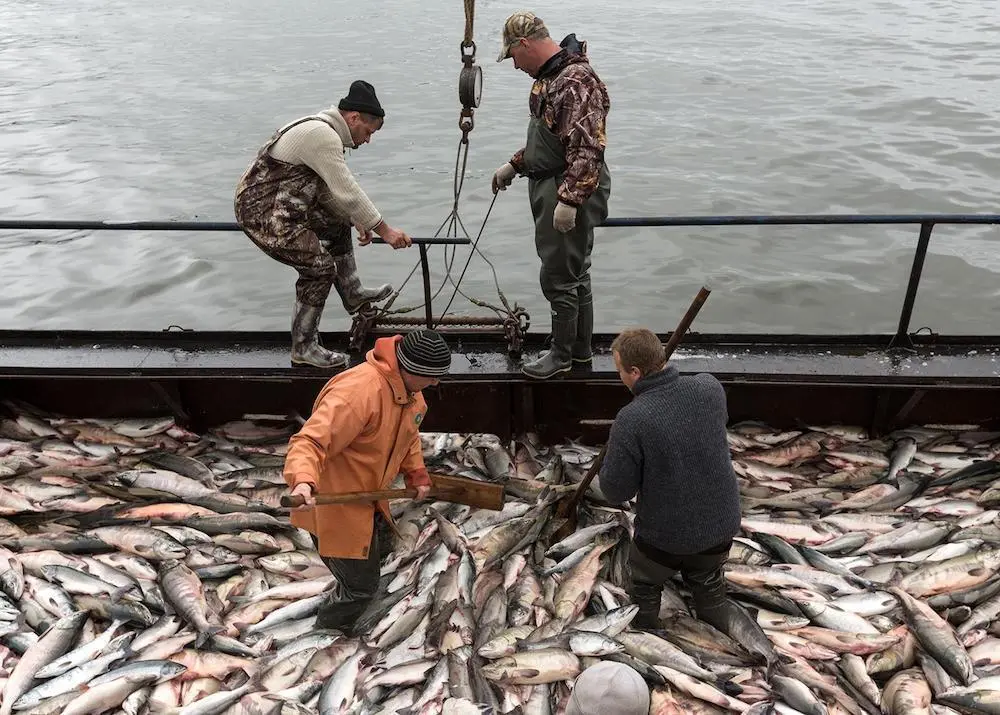
The subject was discussed by experts from both Russia and other countries during the recent Population dynamics, stock status and artificial reproduction of Pacific salmon in the North Pacific conference.
Such a catch reduction could affect not only Russia, but also other major salmon-producing nations, representatives of which also attended the conference. According to analysts, the same situation could occur in Canada, the US, Japan and the Republic of Korea.
As Ilya Shestakov, head of the Federal Agency for Fisheries stated during the conference, after the record salmon catch in the Pacific at the end of the last century and during the 2000s, there is a possibility that we may face its significant decline in the short term.
In 2009, global salmon catch exceeded 1 million tonnes, while in Russia the record was broken in 2018, when catches totalled 680,000 tonnes. According to Ilya Shestakov, in 2020 the volume of salmon catch in Russia significantly declined, while a similar situation is observed by other salmon-producing states.
He commented that there is a need to study the current situation in order to prevent a further decline of catch.
Concerning Russia, the Federal Agency for Fisheries has already adopted a targeted programme for salmon production and has accelerated research activities in this field. Ilya Shestakov stated that Russian science sees a general redistribution of salmon stocks in the North Pacific Ocean, which requires discussion on an international level requiring the participation of some major producers.
Opinion is that due to global climate change, salmon migrate to colder ocean waters in northerly regions. According to Vasily Sokolov, deputy head of the Federal Agency for Fisheries, Russian scientists have already predicted a decline in salmon fishing in the near future.
“We see that stocks of some other fish species, for example, ivasi sardines, are growing, which is in contrast to the current situation with salmon,” he said, commenting that a solution could be to begin artificial salmon reproduction using innovative technologies.
According to Vasily Sokolov, if it is possible to achieve larger and more resilient fry through artificial reproduction, then it will contribute to the increase of stocks.
Suam Kim, President of the North Pacific Anadromous Fish Commission (NPAFC), said during the conference that the decline in salmon production in the North Pacific is “a sign that more salmon reproduction is needed.”
“Over five billion fry are released into the Pacific every year. But this is not enough. The development of artificial reproduction programs can dramatically change the picture of the world’s fish stocks. We are able to preserve the population,” he said.
The conference heard that it is necessary to to select the best time and location for the release of juveniles, so that they can quickly adapt at the coastal stage, before entering the ocean, increasing their chances of survival and ensuring a better return.
Participants agreed to combine international efforts in the study of Pacific salmon. As part of these plans, scientists from Russia, the USA, Canada, Japan and the Republic of Korea will conduct annual joint expedition in the Pacific to study salmon migration sites. The first such international expedition is planned for 2022.
The Russian authorities expect that as in previous years, most of the domestic salmon catch this year will be in the Kamchatka Territory, where up to 359,000 tonnes of of salmon are expected to be produced this year, while the Sakhalin Region and the Khabarovsk Territory are also important for salmon production.
Related Articles
 FISHERIES
 FISHERIES
 WORLD FISHING EVENTS