




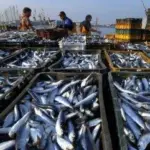

Record low salmon fisheries adopted
The Pacific Fishery Management Council last week adopted the most restrictive salmon fisheries in the history for the West Coast, in response to the unprecedented collapse of Sacramento River fall Chinook and the exceptionally poor status of coho salmon from Oregon and Washington. The recommendation will be forwarded to the National Marine Fisheries Service for approval by 1 May 2008.
“This is a disaster for West Coast salmon fisheries, under any standard,” said Council chairman Don Hansen. “There will be a huge impact on the people who fish for a living, those who eat wild-caught king salmon, those who enjoy recreational fishing, and the businesses and coastal communities dependent on these fisheries.”
The Council adopted a complete closure of commercial and sport Chinook fisheries off California and most of Oregon and allowed only a 9,000 fishery for hatchery coho only off Central and southern Oregon. Salmon fisheries off California and Oregon typically have been large – involving seasons that span from 1 May to 31 October and averaged over 800,000 Chinook caught per year from 2000 to 2005.
“The reason for the sudden decline of Sacramento River fish is a mystery at this time,” said Council Executive Director Don McIsaac. “The only thing that can be done in the short term is to cut back the commercial and recreational fishing seasons to protect the remaining fish. The longer-term solution will involve a wide variety of people, agencies, and organisations. But for now, unfortunately, those involved in the salmon fisheries are paying the price.”
Fisheries north of Cape Falcon will also be severely restricted. Coho quotas are less than 20% of the 2007 season for non-Indian fisheries and about 50%of 2007 levels for
treaty-Indian fisheries. Although Chinook quotas in this area are similar to 2007 and Chinook stocks are generally more abundant, depressed natural coho stocks are constraining access of commercial fisheries to Chinook stocks. Sport fisheries, many of which depend primarily on coho, are even more restricted.
Related Articles
 FISHERIES
 FISHERIES
 WORLD FISHING EVENTS