





Ocean sunfish sampling
Researchers at Perth’s Murdoch University have been conducting a biopsy sampling programme on ocean sunfish for the past 12 months.
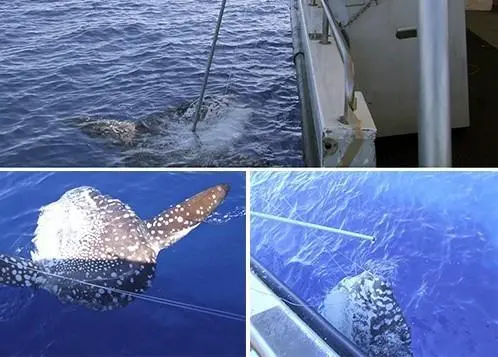
The programme, led by Prof Neil Loneragan and PhD candidate Marianne Nyegaard, has seen Australian Fisheries Management Authority (AFMA) Tuna and Billfish Longline Fisheries Observers travelling from northern Queensland to southern New South Wales, taking tissue samples from sunfish. They catch the fish with a line and then use a 3m long pole mounted with biopsy heads. Once the sample has been taken, the fish are released alive. This is not an easy feat considering that the average adult can weigh more than 1,000kg.
“Their thick skin is tough and leathery, with a several centimetres of connective tissue underneath,” Ms Nyegaard said. “Judging by how many sunfish swim around with healed-up propeller scars and shark-bite-sized bits missing, the shallow biopsies pose little threat to their overall health.”
The study has been focusing on genetic population connectivity between Indonesian and Australian sunfish and looks at the relationship between sunfish caught on the east and west coasts of Australia.
“The observers have been absolutely fantastic and their hard work has really paid off” Ms Nyegaard said. “The support and patience of the longline skippers and crew have been a crucial aspect to the success of the project, and I am very thankful for their cooperation.”
Ms Nyegaard has just completed the first stage of the genetic analysis, and is excited about the preliminary results that have enabled the better identification of sunfish species interacting with Australian Fisheries.
Ocean sunfish are caught as bycatch in the longline fishery for tuna and billfish across Australia and New Zealand, and are released alive. They can grow to impressive sizes, with one individual found off New South Wales in 1907 measuring 3.1m. The sunfish caught in the longline fishery are, however, typically much smaller.
The biopsy sampling project was actively supported by the AFMA Observer Program, as sunfish are one of seven bycatch species listed as potentially being ‘at risk’ in AFMA fisheries because there is so little known about them.
Related Articles
 FISHERIES
 FISHERIES
 WORLD FISHING EVENTS