


NOAA recently took delivery of Pisces, a new fisheries survey vessel and a significant achievement in the agency’s efforts to modernise its fleet of fisheries, oceanographic, and hydrographic survey ships.
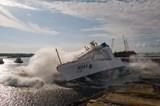
The ship, which will carry a crew of 21 and up to 17 scientists, will support NOAA's mission to protect, restore, and manage the use of living marine, coastal, and ocean resources. Its primary objective will be to study, monitor, and collect data on a wide range of sea life and ocean conditions, primarily in US waters from the Gulf of Mexico, Caribbean, and South Atlantic to North Carolina.
Pisces is the third in a series of four planned 208-foot fisheries survey ships replacing aging ships in the NOAA fleet. It was launched in December 2007 and delivered to NOAA at the beginning of this moth by VT Halter Marine Inc. It will be commissioned and placed into operation in October 2009, after several more months of outfitting and shakedown with its homeport in Pascagoula, Miss.
The data collected by the ship will be used by scientists who study variation in ocean conditions and sea life and how they relate to such issues as sustainable fisheries, fish habitat, habitat restoration, coral reefs, and protected species status. Pisces also will observe weather, conduct habitat assessments, and survey marine mammal and bird populations.
Foremost among Pisces's state-of-the-art capabilities is the ship's “quiet” hull, which minimises underwater sounds made by the ship. This allows scientists to use hydroacoustic methods for surveying marine life, and significantly reduces changes in the natural behaviour of animals caused by ship noise.
“With its dramatically lower background noise levels, this ship will greatly enhance our ability to use the most sophisticated acoustic devices to assess fish, marine mammal and sea turtle stocks,” said James Balsiger, acting NOAA assistant administrator for NOAA's Fisheries Service. “Pisces will not only expand the type of information we are able to obtain, but as a multipurpose vessel will improve our ability to support ecosystem approaches to management of the oceans.”