


In a paper published online last week, a research team led by the Woods Hole Oceanographic Institution (WHOI), has for the first time quantified the amount of drag on entangled whales that is created by towing fishing gear, such as rope, buoys, and lobster and crab traps.
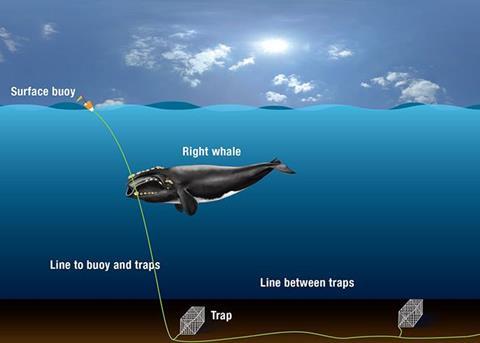
Entanglement in fishing gear is the leading cause of death for North Atlantic right whales. Their migratory routes take them through some of the busiest commercial fishing areas along the East Coast of the United States and into Canada.
Entangled whales can tow fishing gear for tens to hundreds of miles over months or even years, before either being freed, shedding the gear on their own, or succumbing to their injuries.
"We know that entanglement can change a whale’s diving and swimming behaviour and depletes their energy,” said Julie van der Hoop, lead author of the paper and a PhD Candidate in the MIT-WHOI Joint Program in Oceanography, “but the big thing we have never really known is what it must be like for animals to tow the gear. Is it like wearing an empty backpack or is that backpack overloaded with heavy books? Does removing part of the gear improve chances of survival? These are some of the questions that we were looking to answer with this research."
Working with colleagues from the Center for Coastal Studies and NOAA Fisheries, van der Hoop used a tensiometer to measure the drag forces on various types of fishing gear collected from past right whale entanglements. The team tested 16 sets of gear - five sets that included floats or buoys, one that included a two-brick lobster trap and 10 that were line only - towing them behind the WHOI vessel R/V Tioga across a range of speeds and depths.
The team found considerable variation in drag created by the different sets of gear, with the presence of floats and buoys having a significant effect on the overall drag created for the entangled animal.
"Some entanglements have very low drag, for example if a whale is towing 10m of rope, which is basically the length of the whale itself," van der Hoop said. "The weighted lobster trap created the most with three times the amount of natural drag on a whale's body. That's a huge increase in what is normal to these animals."
On average, the team found that entanglement increases the total body drag to 1.5 times that of a non-entangled whale. They also calculated the additional energy costs to the animal.
"Entangled animals have to spend twice as much energy to swim at the same speed," van der Hoop said, based on results from a separate study.
"This study significantly improves our understanding of the energetic cost of large whale entanglement drag forces. These persistent entanglement cases can be a very serious barrier to whales attempting to grow, migrate and reproduce," added Michael Moore, a coauthor and van der Hoop's advisor. "The study also reinforces current disentanglement efforts to minimise entangling gear if it cannot be removed entirely."
The paper was published in Marine Mammal Science.