





Cost-effective stabilisation technology is enabling the upgrade of fish side-streams into food ingredients.
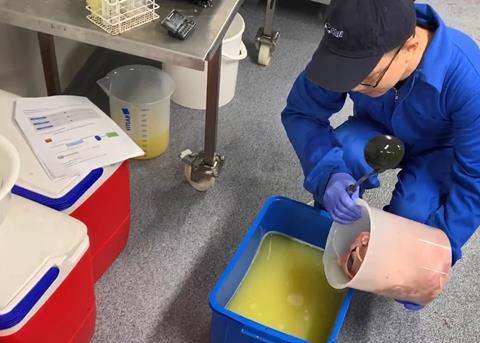
In a recent study, conducted as part of the four-year European project ‘WaSeaBi’ that aims to optimize the utilisation of seafood side-streams by developing new methods to produce nutritional ingredients, a new dipping technology for herring filleting side-streams has been investigated to extend the time before oxidative degradation takes place. The dipping technology is built on a solution containing among others rosemary extract and citric acid.
Results showed that if dipping herring filleting side-streams in the solution prior to their storage at 0 °C or 20 °C, the time until rancidity developed was extended significantly. More specifically, the time could be extended from less than half a day to more than 3 and a half days at 20°C, and from less than 1 day to more than 11 days at 0 °C.
Cost-effective solution
To make the technology cost-effective, the possibilities to re-use the solution was also investigated. Results revealed that even after re-use of the solution up to 10 times, rancidity was completely inhibited at 0 °C. In addition, it was found that the solution kept the fish haemoglobin in a more stable form that is less reactive with the fatty acids, which thereby prevents oxidation.
The new technology gives a valuable window of time for seafood producers to store or transport the side-streams prior to further upgrading into food ingredients, says Ingrid Undeland, professor at the Food and Nutrition Science division at Chalmers University of Technology.
Also, since the dipping covers the side-stream surface with a thin layer of antioxidants, these are carried over to the next process step, providing more high-quality mince, protein- or oil-ingredients, Undeland added.
The study found the solution can be used to prevent rancidity of different kinds of fish side-streams.