


Greenpeace is accusing the Korean Ministry of Oceans and Fisheries (MOF) of failing to regulate the illegal activity of its distant water fleet.
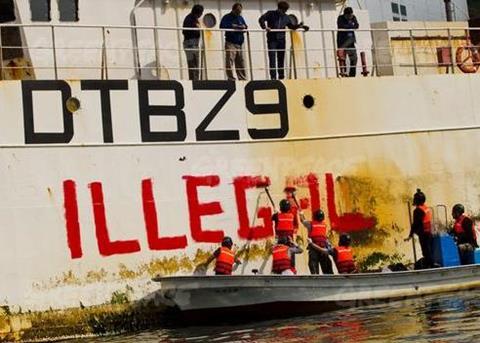
The organisation was protesting against the arrival of the Korean flagged fishing vessel Insung 3 in Busan on Tuesday, with activists painteding “illegal” on the side of the Antarctic fishing vessel to highlight its “involvement in illegal fishing”.
Reportedly carrying 60 tonnes of illegal catch, Insung 3 returned to its home port in Busan to be investigated by the Ministry of Fisheries, following calls from Greenpeace after demanding the blacklisting of the illegal vessel Insung 7.
According to Greenpeace, both Insung 3 and 7, owned by the Korean fishing company Insung, were documented fishing illegally in Argentina’s Exclusive Economic Zone (EEZ) in 2013. The company’s fleet has had a history of illegal fishing in the Southern ocean since 2009, and triggered international debate on the failure of Korea to control their own fleet. The US identified Korea as an illegal, unreported and unregulated (IUU) nation in January 2013, followed by an EU pre-identification as IUU in November 2013.
"The naughty kid is back home and the world is watching to see if Korea has the determination or capability to control its own fleet. These IUU cases expose loopholes in existing legislation where the government does not have the legal ground to take further action.” said Jeonghee Han, Oceans Campaigner of Greenpeace East Asia. “Insung has repeatedly damaged Korea’s international reputation with IUU fishing, and are likely to be allowed to continue their business illegally exploiting the oceans. Insung IUU cases highlight alarming problems with existing legislation”
“If Korean IUU fishing is not urgently addressed, the EU and US may be pushed to give Korea a red card by end of the year”, said Jeonghee Han. A red card would mean Korea can neither sell fish to those countries, nor fish in their waters.