






New technique developed to analyse fish diets
Scientists from the University of Leicester in the UK have developed a technique to perform dietary analysis of fish by analysing microscopic tooth wear.
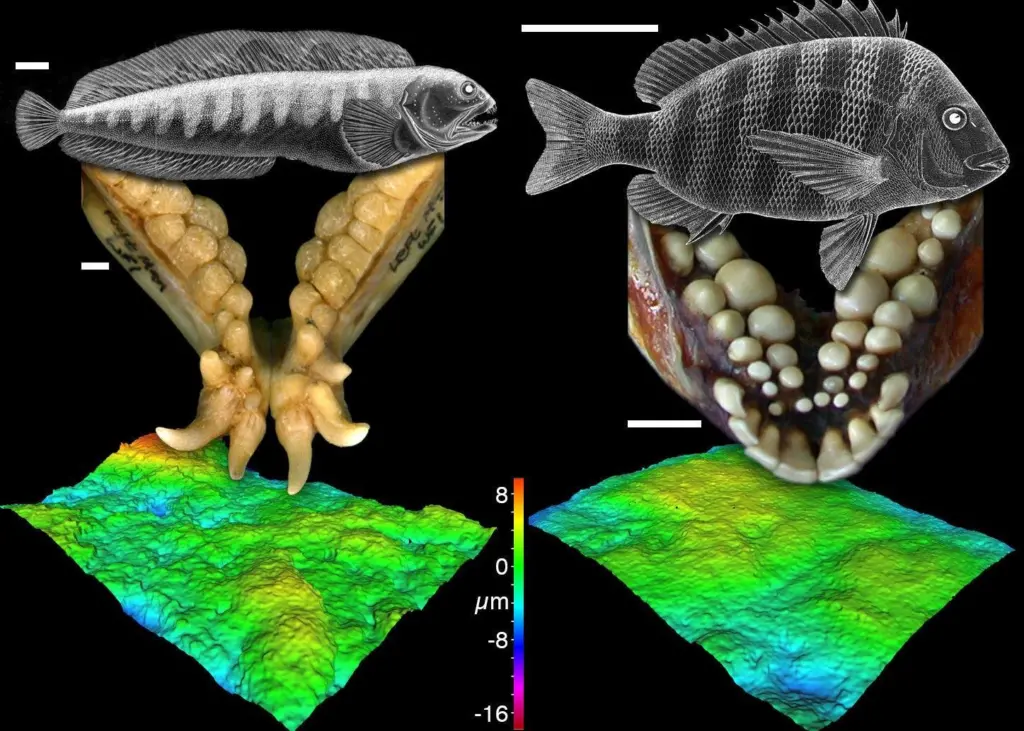
The process, which involves taking moulds of the teeth similar to those a dentist might take, used focus variation microscopy to digitally capture details of the tooth surfaces, zooming in to an area just 1/7th of a millimetre in width – around the same as that of a human hair.
These 3D data allowed the researchers to distinguish between different diet by comparing the roughness and shape of the tooth surface on a tiny scale, offering a new method to analyse fish diets based on the fossil record.
Mark Purnell, Professor of Palaeobiology at the University of Leicester’s Department of Geology, said, “We had a specific question: is it possible to use the microscopic wear patterns on fish teeth to work out what they eat. It’s interesting as the shape of teeth is often used to infer the diet of fossil species – but we’ve seen with living species that they don’t always eat what their teeth seem to be best adapted for.”
The researchers suggest that judging the diet of a species by tooth shape can be misleading.
Professor Purnell explained, “We saw this in this work, where the Sheepshead seabream and the Atlantic Wolffish have quite similar teeth, which look like they are most suitable for a shell-crushing predator. However the Sheepshead seabream, like its mammalian namesake, can have a diet that involves a significant amount of plant material.”
One of the populations of Sheepshead seabream the researchers analysed had such a plant-based diet, and they were able to identify difference in texture between populations with different diets.
The researchers also looked at different populations of cichlid fish, and where able to distinguish between wild fish with a shell-crushing diet (including snails) and pond raised fish fed a more controlled diet.
Professor Purnell said, “The tooth textures pick all this up and the range of species this technique seems to work for was also pleasantly surprising.”
The results are published in the journal Surface Topography: Metrology and Properties.
Related Articles
 FISHERIES
 FISHERIES
 WORLD FISHING EVENTS