




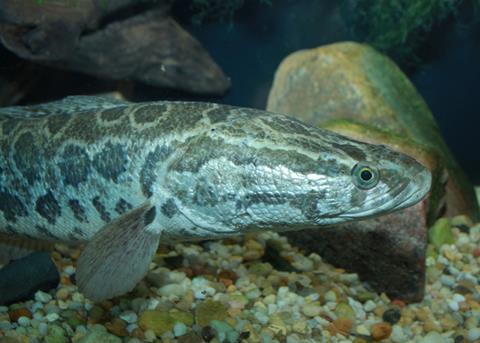
Snakehead (Channidae spp), which lives in fresh and brackish water in Asian countries, is popular with domestic consumers, but not surprisingly the name prevents the species from being marketed on a large scale in Europe, importers say.
However, IQF skinless, boneless snakehead fillets are sometimes sold under other names such as ‘white grouper’ in the USA. And although this is obviously illegal, a different name could provide more market opportunities in western countries.
Snakehead is also sold under the equally unappealing name of ‘mudfish’. However, although the fish are darkish brown in colour, which gives rise to the name, the flesh doesn’t taste at all of mud. It is white or slightly pink when cooked and is slightly sweetish with a good flavour.
The fish is both farmed and caught in the wild in Asia. In Vietnam it is grown in ponds in the Mekong Delta.
As well as being popular in Vietnam, snakehead is also very popular in India and the Philippines, and is one of the most important food fish in Thailand and Malaysia.
Both wild and farmed snakeheads are sold live in Asia, and will stay alive for days in a basket of wet straw. However, it is frozen for export further afield.
Different forms
In Vietnam, for example, it is prepared in different forms: whole skin on/off in 10kg packs; whole gutted in 1kg vacuum packs; fillets skin on/off IWP (Individually Wrapped Pack – wrapped in a thin foil layer); steaks; and sashimi IWP.
The fish is sometimes sold ‘factory cleaned’, which gives a boneless fillet with a yield of about 50%. However, because of the species’ bone structure, extracting the bones will leave a gap in the top of the fillet. This can be filled with an ‘artificial protein’ and then frozen so that it becomes a bone-free fillet. Alternatively fillets can be frozen together.
Snakeheads can grow to 100cm (40in) in length and to 3kg (6.6lb) in weight. A fish 40cm (15.75in) long and weighing 737g (1lb 10oz) will yield about 319g (11.25oz) of skin-on fillet (43%) and 287g (10.1oz) of skinless fillet (39%).
Snakehead became an important Vietnamese export earning “hundreds of millions of dollars” in 2012-13, according to industry sources, and farmers there rushed to grow this valuable crop.
As supplies started flooding the market, the price of snakehead fell from 42,000 Vietnamese dong ($1.88) to 26,000 Vietnamese dong ($1.67) per kg. However, production costs were reported to be 30,000 Vietnamese dong ($1.35) per kg.
In 2014, intensive farming took its toll and snakehead ponds were abandoned as prices plunged. The problem was exacerbated by a rash that left many fish with ulcerated skin.
Farmers in the province suffered individual losses of between 80 million and 500 million Vietnamese dong ($3590-22,440).
The price then recovered and in July 2015 ranged from 45,000 Vietnamese dong ($2.02) to 60,000 Vietnamese dong ($2.69) per kg on leaving the farm. This was two-to-three times the farm gate price for pangasius at 25,000 Vietnamese dong ($1.22).
It will be interesting to see if snakehead can continue to earn this price and emulate the success of other freshwater fish farmed in Vietnam such as pangasius and tilapia.