




New Multi-Function Door Angle Sensor
Marport has announced the commercial release of its new Multi-Function Door Angle Sensor this month.
The multi-axis sensor continuously measures trawl door motion and sends the data to the vessel via an acoustic link.
The new sensor integrates a multi-axis accelerometer/inclinometer, a digital temperature sensor, a high precision depth sensor, power management circuitry, embedded signal processing firmware and broadband transducer technology for reliable underwater acoustic communications. The multi-function design has enabled Marport to create a small, cost-effective sensor solution that provides high resolution trawl door motion measurement.
The unit achieves high reliability as the sensing elements are solid state and do not have any moving parts. The sensor uses Marport’s software defined acoustics technology to meet future fishing requirements. By being able to upgrade the sensor software, operators can protect their investment and remain at the forefront of fishing technology.
A trawl can be hundreds of metres long and moving it through the water requires a tremendous amount of energy. Towing with improperly positioned trawl doors can cause undue stress and will negatively impact fuel consumption. Fisheries gear researchers have shown that during trawling less than 10% of fuel is consumed to propel the vessel while over 90% of fuel is consumed to move the trawl gear through the water.
Karl Kenny, Marport President & CEO said, “Wild fish harvesting is one of the most energy-intensive forms of primary food production. For many operators fuel expenditures constitute more than 70 per cent of their total operating costs. With today’s rising fuel prices, fishing vessels must operate as efficiently as possible. For the past several years, Marport has been designing sensor innovations that can help increase both vessel fuel efficiency and trawl catching performance. With our new Multi-Function Door Angle Sensor, operators can constantly observe trawl door motion which will help them correctly rig the doors for prevailing ground and sea conditions.”
Marport’s latest sensor is the first in the commercial fishing industry to integrate the following functions into a single sensor:
• Angle of attack
• Roll angle
• Pitch angle
• Depth
• Temperature
Angle of attack
This is the angle between the shoe of the door and the direction it is being towed. Research indicates that an optimal angle of attack can save approximately 8% in fuel costs.
If the angle of attack is set too high the door spread will not be maximised and fuel efficiency will decrease. Gear researchers recommend that the optimal angle of attack is between 28-30 degrees.
There are many reasons to monitor angle of attack. For example, strong side currents or winds can offset a trawl from the tow path causing one door to operate at a different angle of attack than the other. Any significant change in door behavior will immediately affect trawl geometry. Also, if one door is set faster than the other, one of the doors could operate at a greater angle of attack and pull the trawl off-center for the entire tow.
Roll angle
This angle refers to the door’s natural behaviour to lean inwards or outwards during towing.
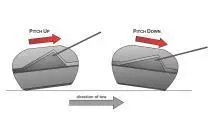
Pitch angle
A trawl door is described as pitching when it is lifting up at the front or rear of the door while being towed.
Heel and pitch angles are affected by a combination of height of the warp attachment point; the amount of warp paid out, door weight; ground conditions; rigging and towing speed.
Depth/temperature
The sensor also incorporates a depth function that measures trawl door depth as well as the door descent/ascent rate when shooting/hauling. The depth sensor provides vital information to help place the trawl doors at the desired depth in the water column. The sensor’s temperature function measures water temperature around the trawl door. Monitoring the water temperature reduces time and fuel spent towing in waters that are not suited to the target species.
All five sensor functions can be simultaneously processed and displayed by Marport’s acoustic receiver cabinet. Only three of the sensor functions (pitch angle, roll angle, depth or temperature) can be processed by competitors.
The sensor also incorporates the latest deep-sea rated lithium ion battery technology which has up to 10 times the life of competitive products. Operators can expect at least 21 days battery life on a single charge. The Marport sensor also includes Active Power Measurement. This feature transmits the sensor’s real-world power consumption as well as remaining battery life to the operator.
Sensor operation
The Door Angle Sensor continuously measures trawl door motion and sends the data to the vessel via a wireless acoustic link. The signal is decoded by Marport’s multi-band acoustic receiver and transmitted to the bridge computer. Marport’s CommandView software graphically displays and records real-time door performance. Sensor information can be displayed in numerous configurable formats such as digital gauge, analog gauge, history strip chart and 3D model format. Alarms will sound if the trawl door motions exceed operator specified operating limits.
Marport’s receiver and bridge equipment can process and display data from up to 37 different net monitoring sensors (door distance, door angle, trawl speed, catch sensors etc.) The system also supports a variety of net sensors from other manufacturers.
The system has a data store/replay function that can store hundreds of hours of date/time-stamped door motion data as well as all navigation data such as lat/long, COG, SOG, etc. The sensor also incorporates flash memory storage for up to four gigabytes of real-time, unfiltered data. The data set includes all of the raw data from the underwater signal allowing highly accurate post processing. The sensor uses Bluetooth wireless links to download raw data, as well as for uploading new signal processing software to the unit. Bluetooth is a communications protocol primarily designed for low power consumption and a short transmission range (2 to 100 metres).
Related Articles
 FISHING TECHNOLOGY
 FISHING TECHNOLOGY
 COMMENT