


New line for automated egg handling and fertilisation
Aqua Gen is installing a new automated production line that ensures standardised and optimal treatment and fertilisation of the newly stripped eggs.
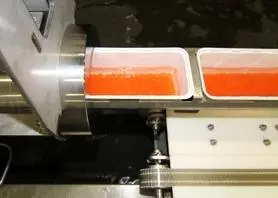
This development is in response to the need for increased capacity and gentler handling of the eggs in the production of sterile fish.
Traditionally, stripping of eggs, fertilisation, rinsing etc., has been carried out manually. In the new automated line, eggs and milt will still be removed from the fish manually, but subsequent procedures, including fertilisation and rinsing before and after fertilisation takes place, will be carried out automatically, with improved control in a mechanical process. Disinfection of eggs and transfer to the incubators will also be done manually.
The new equipment is about to be tested and fine-tuned, and Aqua Gen plans to use the device fully from the coming egg season.
Egg transfer
In the autumn of 2012 Aqua Gen produced eggs to allow the testing of large-scale production of sterile, triploid fish in five fish farming companies. As a part of this project, sterile eggs will also be produced in the next two egg seasons. If the demand for sterile eggs continues, triploidization will be a bottleneck in egg production in term of capacity. Triploidization is done by transferring the eggs to a steel pressure cylinder about half an hour after fertilisation and subjected to hydrostatic pressure at 655 bars.
The largest commercially available pressure chamber holds only 10 liters, and the filling and emptying of the chamber means a physical stress on eggs at a very vulnerable stage. To do something about this and increase the capacity to produce sterile eggs, two pressure chambers are to be installed in the new production line. These chambers will lie horizontally, and trays containing eggs will be inserted in these, which avoid the eggs being poured in and out.
The timing of the pressure treatment in relation to fertilisation and treatment duration are determined by the water temperature, and must be controlled precisely. The automatic line provides far greater precision with increased throughput than is possible manually.
Aqua Gen says that the new production line is unique in its kind. The automation is based on an industrial robot and the development project is conducted in cooperation with Maskon AS.
Related Articles
 AQUACULTURE
 SEAFOOD
 SEAFOOD