



For the Niger Delta''s less well off small scale farmers, a lack of return on investment is particularly serious if there is no break-even or profit margin at the end of their production circle. Many of Nigeria’s farmers left the industry as soon as profits were either small or non-existent in relation to their efforts, reports Lilian Elekwachi.
The Chevron Initiative came up with an agenda called Partnership Initiative in the Niger Delta (PIND) to work with small scale farmers in aquaculture and other agricultural sectors, using a new approach. The Market Systems Development (MSD) or Making Markets Work for the Poor (M4P), is designed to change the way aquaculture markets in the Niger Delta work, so that poorer farmers can benefit from the growth and economic development of the sector.
The major objective is to tackle market failures and help poor fish farmers to increase their productivity and yield, as well as to reduce poverty and create job opportunities. According to Market System Development specialist Elekwachi James, when they came to the Niger Delta for the aquaculture intervention project, they encountered difficulties in getting the farmers to sign up for training, who were very reluctant to accept them because they there had been similar donors and government advisors in the past who came but never achieved anything tangible. Most of the farmers believed that MSD officials were wasting their time, hence their lack of intererst. However, the MSD officials were persistent, and were able to convince a few farmers to undergo the training and radically change their business plans.
When others saw that those who had been trained were making significant amounts of money, they quickly keyed into the system and the number of trained fish farmers rapidly doubled as new entrants quickly flooded the system.
The Market System Development approach has three elements; production, processing, and marketing. On production, the PIND foundation contacted two fish feed companies – Ranan Feed and Vital Feeds – who donated fish feed for the demonstration, fingerlings company Brafin Hatchery, which agreed to supply fingerlings, and farmers’ group United Ufuoma Fish Farmers Association (UUFFA) which assumed responsibility for the day-to-day management of the demonstration and also donated ponds.
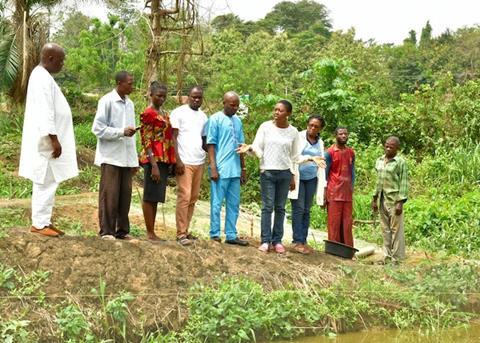
The Usaid Markets 11 project and the PIND foundation provided a consultant, Dr Okoro, who has a PhD in Aquaculture and Fisheries, to oversee the knowledge transfer relating to the demonstration ponds. On the 13th of January last year, four ponds were stocked for the demonstration. Two of these served as control sites, which were not given experimental treatment but continued with their normal practice (including using homemade fish feeds) while the other two were the experimental ponds, set up to trial the new technology, sorting, fertilising the ponds, and using biomass for feeding.
It was discovered that after six months when the fish in all four ponds were harvested and sold, the profit margins from the two experimental ponds increased from 5% to 22%. This is because the cost of production drastically dropped, as feeding by biomass reduced over-feeding and feed wastage, resulting in cost savings. The yield also increased, because the fish are being fed at the right time. The result of saving a lot of feed at the beginning part of the experiment enabled the operators to feed the fish until they reached table size without running out of feed, which had invariablly happened under the farmers’ normal practice. Many farmers quickly adopted the new practices – and more and more people moved into fish farming.
Dr Okoro who supervised the demonstration of the practice left as his contract came to an end, but the farmers he had trained were knowledgeable, skillful, young and entrepreneurial, and some of them started teaching new entrants and existing farmers. These entrepreneurs are UUFFA farmers, and today, there are nearly 60 consultants from UUFFA who are delivering training, providing advice and information and transferring technology to existing fish farmers and potentially new fish farmers, all of whom are operating profitably.
Another introduced component was training in the Nigerian Agricultural Enterprise Curriculum (NAEC), which is the business side of catfish farming management which helps farmers to keep records which tell them whether they are running at a profit. So the new consultants were combining NAEC training with technical delivery of the MSD approach.
After the first harvest, the PIND foundation turned its attention to smoking the harvested fish, which prolongs the shelf life of the fish after harvest and consequently provides the farmers with greater bargaining power in selling their product. Another benefit of smoke-processing is that it decreases the cost of production. This is because when the fish reach table size, they continue to consume a lot of feed and if the farmer doesn’t have a ready market, he can slaughter the fish and therefore stop feeding it, while smoking the fish and adding value to it. Smoked fish commands a higher price because it gives a unique taste that goes with Nigerian native delicacies.
The PIND Foundation improved the quality of processing by introducing two new types of processing methods, first smoking kilns, and secondly chorkor ovens offering a cheaper technology for fish smoking, albeit not as efficient as smoking kilns. However, both types are better than the traditional fish smoking technology that introduces a lot of smoke to the final product, making it unhealthy for both processors and consumers.
The smoking kilns technology was the brainchild of the Nigerian Institute for Oceanographic and Marine Resources (NIOMR). The PIND Foundation obtained from NIOMR blueprints for smoking kilns and engaged a local fabricator produce kilns which were then promoted. The Chorkor oven was copied from Ghana, where it is quite common, and the PIND Foundation brought it into Nigeria as well, using local masons to build these, where this method is particularly common in the Nigerian riverine communities.
Marketing presented no great problems, as more than 50% of the fish consumed in Nigeria is imported. Demand exceeds supply and so there is a ready market for the product. All that Niger Delta fish farmers needed was to find ways to produce more efficiently so they could compete with imports. They managed this by reducing their costs of feed, which is the major cost component, and so they could keep their selling prices low which would help them compete with the international importers.
According to Chief Joshua Ughere, who has been a fish farmer for over 30 years and Chairman of the UUFFA Board of Trustees, commented after the PIND experiment, this initiative has led to significant improvements in productivity, yield and sales of the farmers due to good working practices and access to new markets.
He said that average profit per fish farmer rose dramatically, largely as a result of increased yield resulting from application of better management practices and cost of production reduced because of the production technologies adopted by the farmers. What the fish farmers were previously doing wrong was corrected – a lot of wastage of feeds had occurred without the farmers knowing; and proper sorting drastically reduced levels of mortality through cannibalism. The majority of farmers changed their attitude to farming and more people joined the cluster. At the end of the experiment, the demand for Vital and Ranan feed rose by over 30%, as existing farmers maintained their use of these two feeds and other farmers who were trained by the new consultants followed suit.