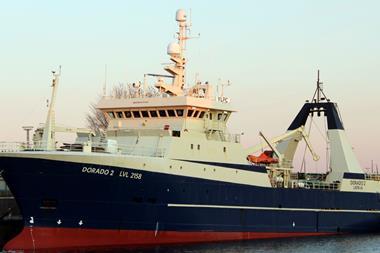





According to Agencia de Informacao de Mocambique (AIM), the Mozambican government is studying ways to reduce the tax on diesel used by vessels fishing for prawns.
Fisheries Minister Cadmiel Muthemba told AIM that this measure aims at solving the crisis the fishing companies are facing. Some claim that the high costs of fuel are bankrupting them.
Muthemba said that a team from the Fisheries and Finances Ministries is studying the possible effects of reducing the tax, currently fixed at 3.73 meticais per litre (at current exchange rates, there are about 25.7 meticais to the US dollar).
However, businesses in fisheries, agriculture and industry have already received tax reductions, and are only paying half this amount. Nonetheless, the fishing operators claim that it is still too much.
"I hope to have some solutions before the end of this year, to enter into force by 2008", said Muthemba. So the fishing companies will receive no relief for this year's prawn fishing campaign, which ends in November.
Muthemba acknowledged that fuel accounts for about 50 per cent of the operational costs of prawn fishing. He said that of the 56 licensed industrial fishing ships, on average, between March and June, four of them were not putting to sea due to the high costs of fuel.
The secretary general of the Mozambican Industrial Prawn Fishing Association (AMAPIC), Joao Mangave, told AIM that the problem can only be solved if the government completely removes the tax on fuel for fishing vessels. Another possible solution would be to revoke the monthly quotas of fuel for each boat, he said.
Although acknowledging that the real consumption of fuel in the fishing industry is far higher than the fixed quotas, Muthemba says that what will happen is a reduction of the tax, not its total removal.
"We will perhaps not eliminate the tax, maybe we will reduce it a little further, but this is still under study, and we do not know to what extent it will be reduced. But we will work on the data for real consumption", he said.
Muthemba also noted that the problem for the fishing industry is not simply the tax on fuel, but also the fall in the price of prawns on the European market because of competition from aquaculture prawn producers in Asian and Latin American countries. They can sell cheaper prawns, because their production costs are lower.
Muthemba said that prawns represent about eight per cent of the country's exports earnings, bringing in more than 96 million US dollars in 2006.